SEPTEMBER 2023 RELEASES
September 2023 Releases
Every day, enterprises deploy AI agents to handle thousands of customer interactions, resulting in massive volumes of conversational data, rich with signals about what customers want, where they’re getting stuck, and how the agent is performing overall.
Extracting those insights is incredibly difficult, however.
The way people speak is inconsistent and imprecise, making it nearly impossible to group related conversations using strict keyword matching. Similar ideas can be phrased in dozens of different ways. Without bringing structure to the data, patterns stay hidden.
As a result, transcript data remains one of the most underused sources of learning for improving AI agent performance. It also serves as a powerful form of business intelligence, revealing what customers need, want, and object to at scale.
While managers and operators can review some calls manually, it’s simply not possible for anyone to listen or even read through every transcript.
Incomplete review leads to missed insights, which leads to missed opportunities for improving customer experiences and optimizing your AI agent’s performance.
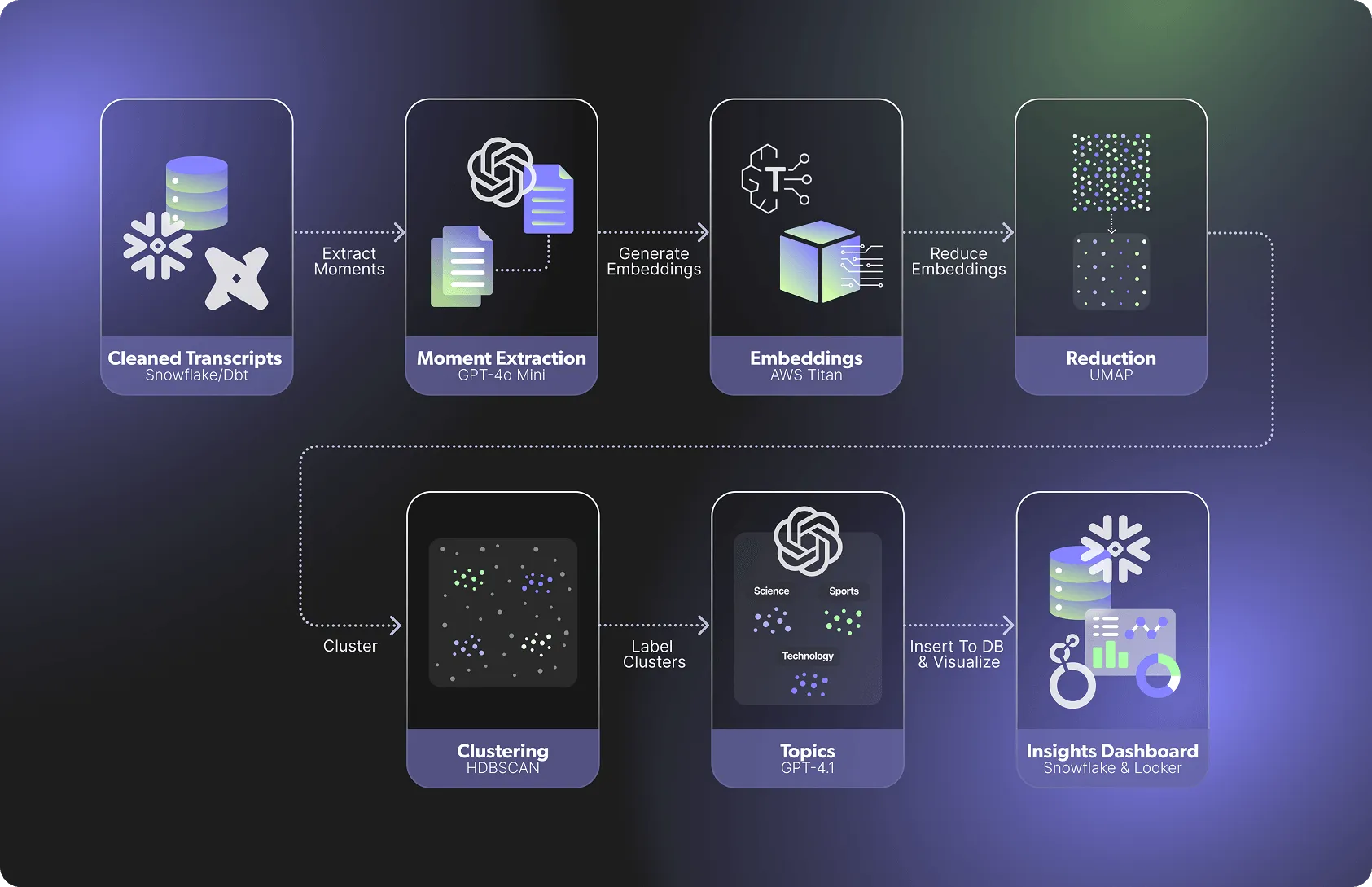
To tackle this challenge, we've developed a streamlined approach to automatically extract and understand meaningful customer moments from transcripts.
By leveraging advanced LLMs like GPT-4o mini, we pinpoint crucial moments from every call (customer questions, objections, reasons for calling, etc.).
We then enrich them with essential context, making each statement independently clear and insightful.
These enriched conversational moments are then converted into numerical embeddings using AWS Titan V2, allowing us to identify hidden patterns and conversation themes through sophisticated clustering techniques like Uniform Manifold Approximation Projection (UMAP) and Hierarchical Density-Based Spatial Clustering of Applications with Noise (HDBSCAN).
Finally, we use GPT-4.1 to clearly label these clusters, translating dense data into intuitive, human-readable, business-friendly insights.
The end result?
You gain rapid clarity on customer concerns and interests, enabling smarter decisions and more meaningful customer interactions.
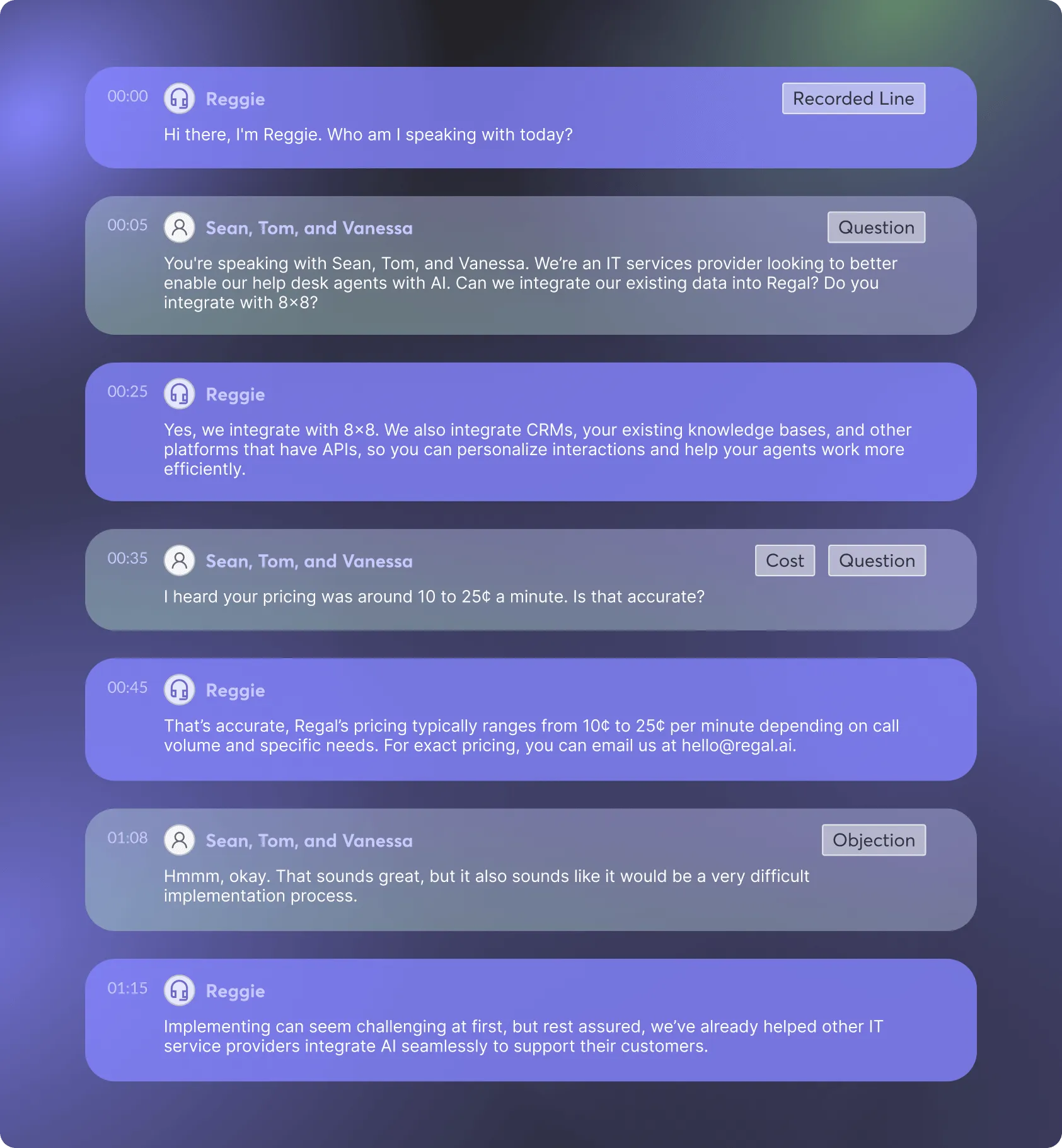
To bring this process to life, we’ll follow a real transcript from Regal’s inbound AI agent, Reggie.
As we go through each step of the process below, I’ll refer back to this transcript to show examples of how it’s transformed into structured, actionable insights.
For context, Reggie is an enthusiastic AI agent we use at Regal to introduce our value proposition to customers and prospects.
Reggie answers common questions, and engages with users in a Regal-branded way.
Here is the transcript between Reggie and a Regal customer:
To ensure our input conversation transcripts are reliable we start by aggregating moments into a turn-by-turn, speaker role-based transcript with the help of a DBT model to create a Snowflake table as our input.
To reduce noise or false insights, we only analyze transcripts that have at least four conversational turns, where genuine interaction occurred according to call disposition data, excluding any dialogue after the AI agent transfers the call.
Then, we employ GPT-4o mini to pinpoint and enrich key moments such as customer questions, objections, reasons for initiating contact, and decisions.
This careful extraction ensures we focus on valuable exchanges rather than routine interactions.
Each extraction falls into one of these categories:
We specifically tell the AI to discard:
This filtering ensures that we only focus on rich, actionable moments in the conversation.
After extraction, we instruct the AI to enrich each moment by adding relevant context from surrounding parts of the conversation.
Each enriched moment provides clear, standalone context that transforms extensive conversational data into easy-to-understand, actionable insights, making it straightforward for your org to respond effectively.
Let's revisit our earlier example with our AI agent, Reggie, speaking to Sean, Tom, and Vanessa.
From their conversation, GPT-4o mini helps us identify and clearly articulate critical customer moments and what category each moment lives.
{ "extraction_number": 1,
"category": "reason",
"enriched_moment": "looking to use a technology like Regal AI to enable help desk agents support customers more efficiently" },
{ "extraction_number": 2,
"category": "question",
"enriched_moment": "can we integrate our specific data, do you integrate with 8x8?" },
{ "extraction_number": 3,   "category": "question",
"enriched_moment": "Is it accurate your pricing is around 10 to 25 cents a minute?" },
{ "extraction_number": 4,   "category": "objection",
"enriched_moment": "the process to implement AI seems too difficult, I don't think we are ready" }After we identify and enrich meaningful moments from conversations, we need to translate these text-based insights into something computers can easily understand.
In this case, we turn them into numerical embeddings.
Think of embeddings as coordinates on a map: Where similar ideas and phrases land close to each other, making it simple for algorithms to spot similarities (and therefore patterns) between similar data points.
We use a powerful embedding model called AWS Titan V2 to transform each enriched conversational moment into a dense numerical representation.
Imagine phrases like "refund delayed" and "why is my refund late?"
Even though these phrases are slightly different in language, they’ll end up close to each other in the embedding space because their meanings overlap.
Consider singular words “dog” and “puppy.” Let’s turn them into numbers. At a high level, the text gets tokenized, meaning puppy is split into “pup” and “###py.”
We then map these tokens to vectors and refine them by looking at surrounding tokens. These vectors are pooled and normalized to create ‘embeddings’:
Each position (dimension) is a learned feature discovered by the model during training. These dimensions don’t have neat human labels, but you can think of them as abstract gauges the model dials up or down.
You can probe them, but they’re best treated as coordinates where distance encodes meaning. To build intuition, here’s a fictional abstraction of the first three dimensions:
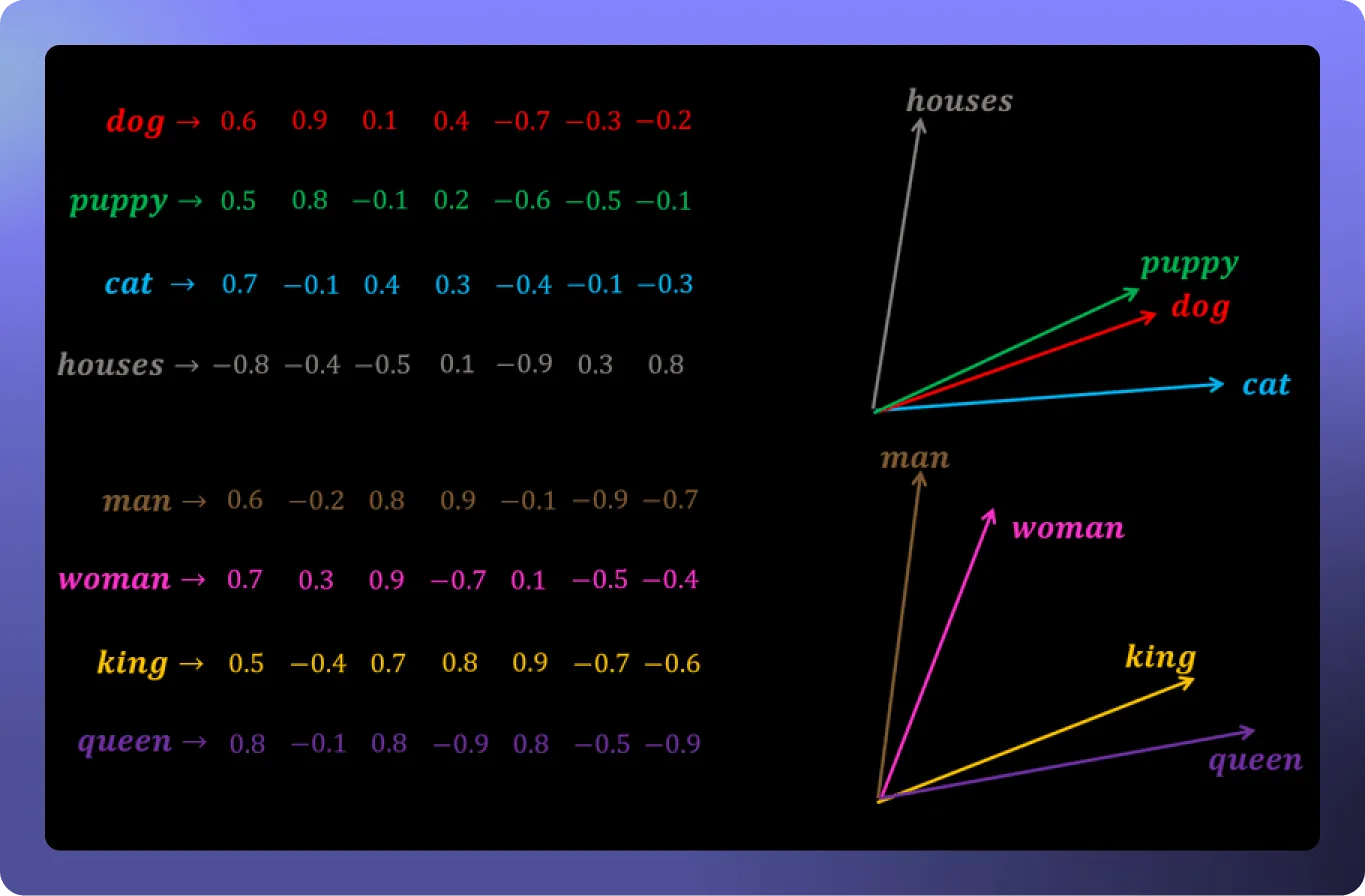
Each individual word here has seven dimensions. As you can imagine, those dimensions build greater meaning and compound when words are put together in a full sentence.
When embedding an entire sentence, a vector can have upwards of 1,000 dimensions. You can’t visualize 7D (let alone 1,000D).
Since these embeddings get so complex, we use dimensionality reduction techniques (like UMAP) to project the embeddings into 2D diagrams that preserve local neighborhoods (i.e. preserve essential information).
Distances and clumps reflect semantic similarity, not human-named axes. For example in the above plot, if a vector connecting “man” to “woman” captures a gender relation, a similar offset might connect “king” to “queen.”
We simplify these embeddings into a smaller N-dimensional space from the origin, which makes broader patterns easier to spot for our clustering algorithm.
Let's take one moment from Reggie’s conversation, this Customer Question:
"Can we integrate our specific data… Do you integrate with 8x8?"
A sentence embedding is going to be richer than a single word because the The AWS Titan V2 model encodes all tokens together, letting words shape each other’s meaning.
In this example, “Integrate” shifts toward “software/platform interoperability” because it co-occurs with “data” and the vendor entity “8x8” (a communications platform).
The pooled output becomes one vector (e.g., 1,024-D from Titan V2) that captures intent (“integration request”), entities (8x8), and topic (data/system interoperability), not just isolated words.
That’s why a sentence embedding is richer: It represents meaning, intent, and topics, and brings context to phrasing, which is exactly what we want for clustering conversational moments.
Our example would generate numbers as represented below. In this case, we show the first 20 dimensions out of a total of 1,024:
[0.23, -0.17, 0.34, 0.89, -0.56,
0.12, -0.44, 0.67, 0.09, -0.31,
-0.78, 0.24, 0.85, -0.26, 0.19,
-0.14, 0.94, 0.19, -0.36, ...]
(up to 1,024 dimensions total)
UMAP simplifies the above embedding instead into:
[0.45, -0.29, 0.74, -0.03, 0.52]
This UMAP reduction starts by building a neighbor graph in 1,024-D. Within those dimensions, it finds five new axes that preserve all the essential information (i.e. neighborhoods).
Those five coordinates don’t have fixed semantic labels; instead, they become the new axes that best maintain the closeness of other embeddings.
This reduced representation produces enough capacity for clustering (HDBSCAN), while dropping noisy or redundant variance.
Once we've converted conversations into simplified numerical representations, the next challenge is discovering meaningful patterns.
This is where clustering comes into play.
We utilize a powerful algorithm called HDBSCAN (Hierarchical Density-Based Spatial Clustering of Applications with Noise) to identify patterns.
Unlike traditional methods that require us to specify the number of topics beforehand, HDBSCAN automatically finds natural groupings by identifying dense pockets of similar conversation moments.
Think of it as a way of spotting busy neighborhoods (clusters) and lonely outliers (noise) on a map.
To ensure groupings are meaningful, we can control and optimize this algorithm with parameters such as:
As a result, we're able to uncover real, significant patterns whether customers repeatedly question pricing, express concerns about implementation, or frequently inquire about integration capabilities.
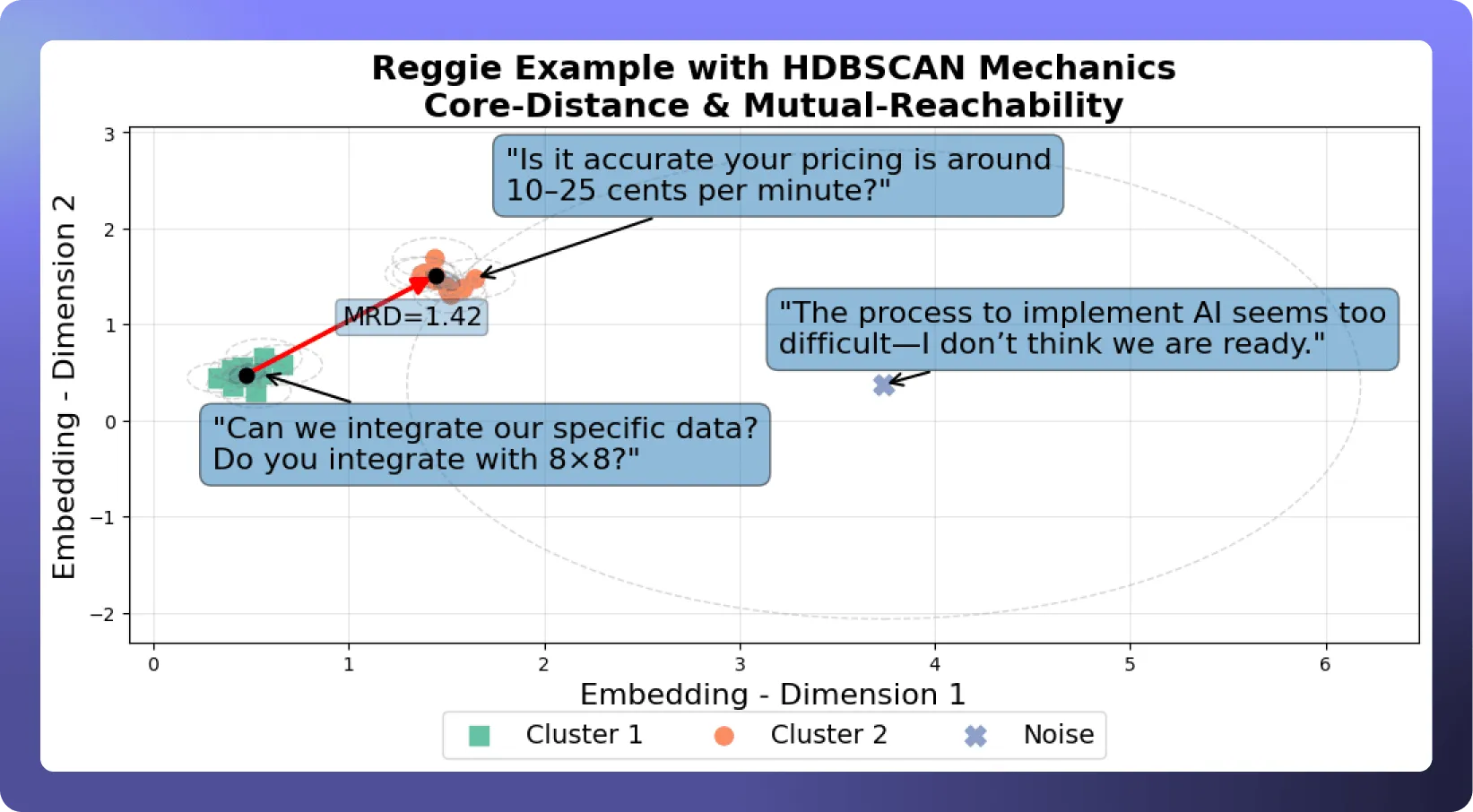
Let's revisit our example with Reggie and imagine we have extracted conversational moments from all of Reggie's conversations, not just with Sean, Tom, and Vanessa. Then we converted those conversations into embeddings, then visualized them as points.
HDBSCAN might group their questions about data integration and pricing closely together, showing these as prevalent, common topics.
Conversely, the isolated moment where they express concerns about AI implementation might be identified as noise (if few other customers raised similar concerns).
Visualization Key:
Identifying clusters is powerful, but translating them into actionable insights requires further clarification.
This is where GPT-4.1 steps in, transforming all these groupings into intuitive labels and concise descriptions that anyone in your organization can easily understand.
For each identified cluster, we take representative conversational moments along with our defined "Agent Goal" (what the AI is trying to achieve during interactions) and instruct GPT-4.1 to craft clear, relevant labels.
Each label succinctly summarizes the underlying theme or customer concern of that cluster. To further simplify interpretation, we organize these individual labels into broader "parent topics."
For instance, detailed questions or comments about pricing (e.g. “Are there fees associated with integration?” or “That fee seems high for what we can afford”) can be grouped under the broader parent topic of "Pricing & Cost Concerns."
This hierarchical approach enables you to quickly grasp overarching themes and see, at a glance, what customers frequently discuss or express concern about—and take meaningful action to address those concerns.
Okay so, back to Reggie's conversation with Sean, Tom, and Vanessa. After clustering, here's how GPT-4.1 might label each meaningful conversational moment:
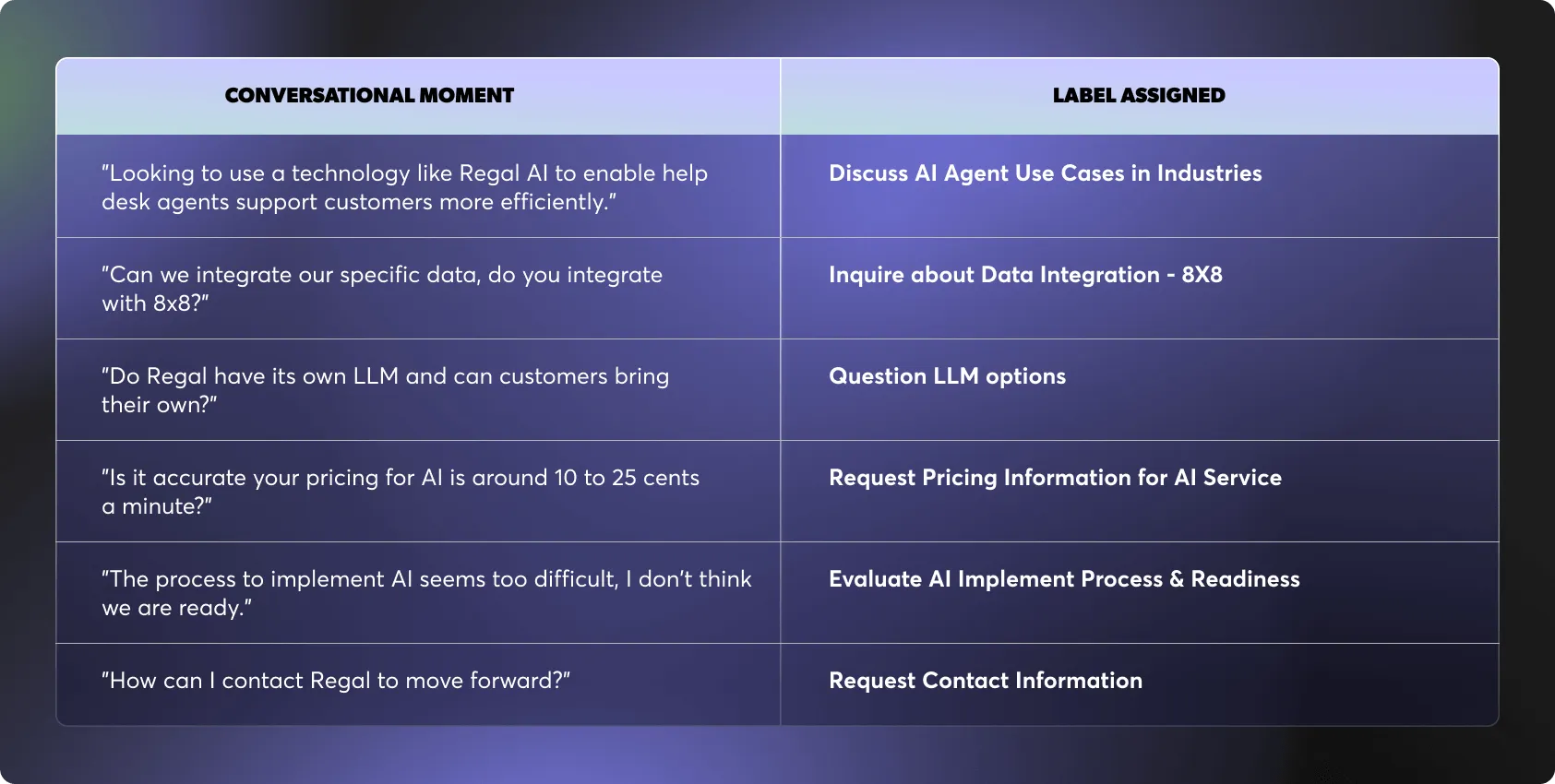
Turning complex conversational data into actionable insights is the ultimate goal here.
Clearly labeled clusters, enriched with context and grouped into intuitive topics, empower you to make informed, strategic decisions quickly.
We tie conversational topics to configurable success metrics like conversation duration, sentiment analysis scores, and call transfer rates, so you can identify which types of conversations need work and proactively take action to fix them through prompt or Knowledge Base updates.
In order to consume these insights, it's important the data is structured in a manner which makes key information readily available.
This output is written back to Snowflake, where all the rich conversational intelligence we’ve extracted and labeled comes together in a business-friendly format. This table serves as the single source of truth that your organization can consume, analyze, and act on.
Each row in the table represents a meaningful moment from a conversation, enriched, categorized, and clustered for easy interpretation. Here are the key fields that brands care about:
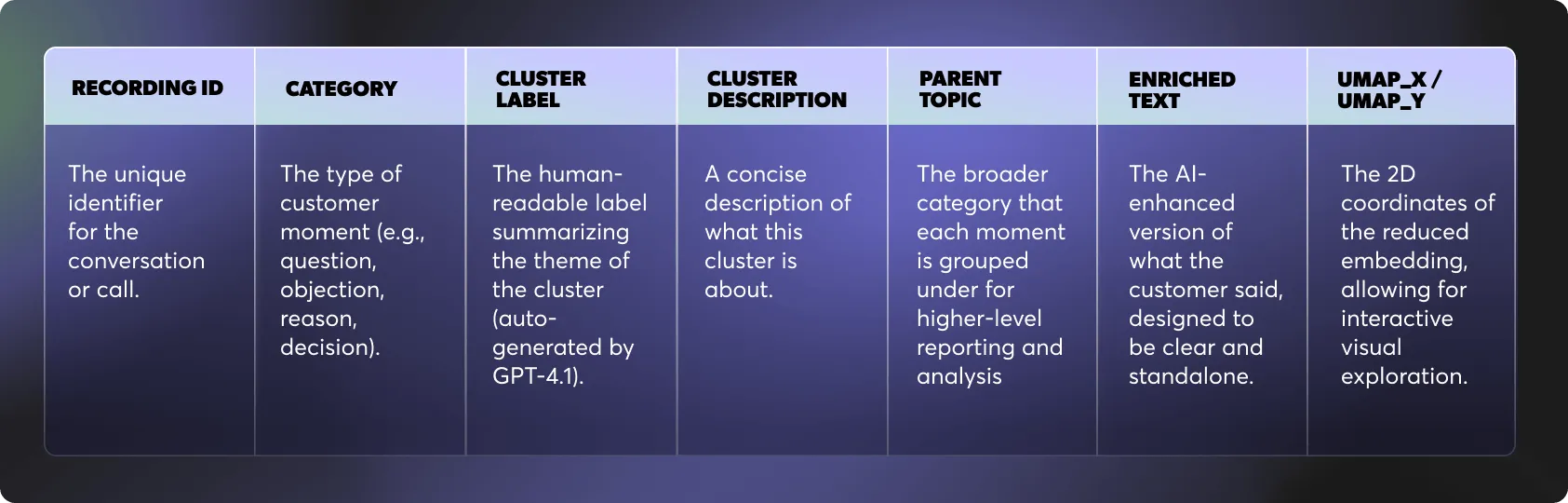
Teams can analyze these fields to:
For example:
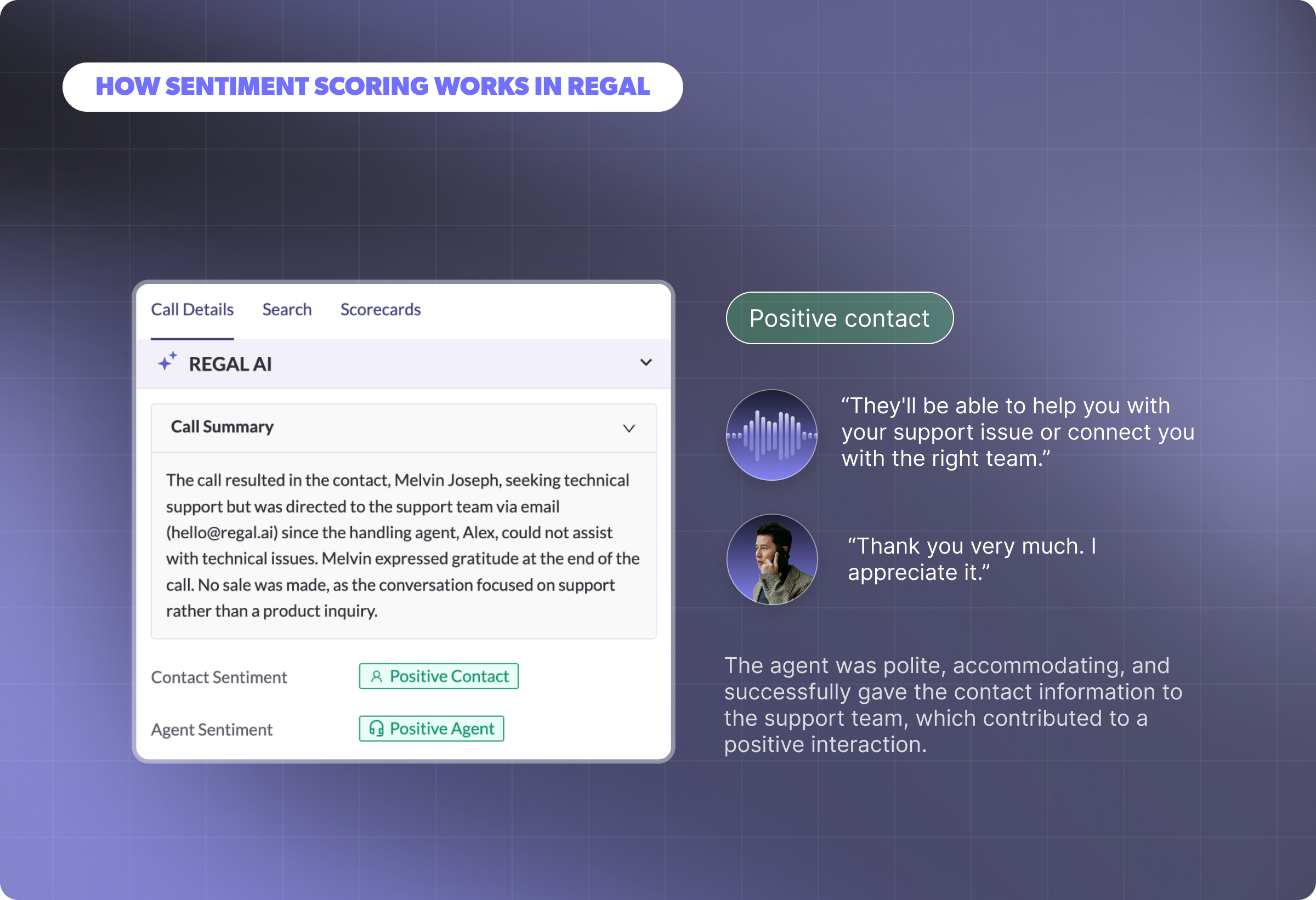
Using our Reggie clusters, we see that calls where Regal prospects ask about integration with 8x8 have higher-than-average call durations and negative customer sentiment.
We then dig into those transcripts and notice the AI Agent isn’t providing clear integration steps or addressing data security concerns. That signals the opportunity to update the AI Agent’s objection handling to cover those points directly, and expand the knowledge base with detailed integration instructions and security information so the agent can surface them in real time.
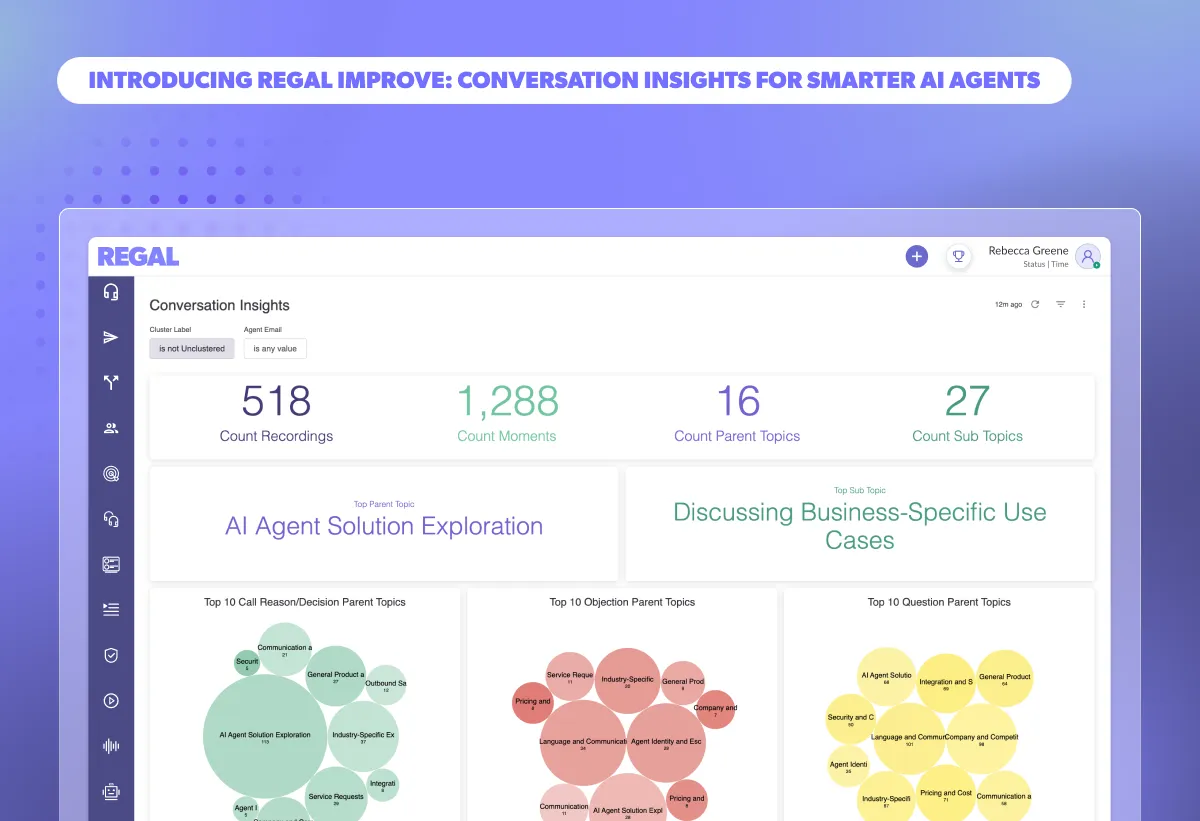
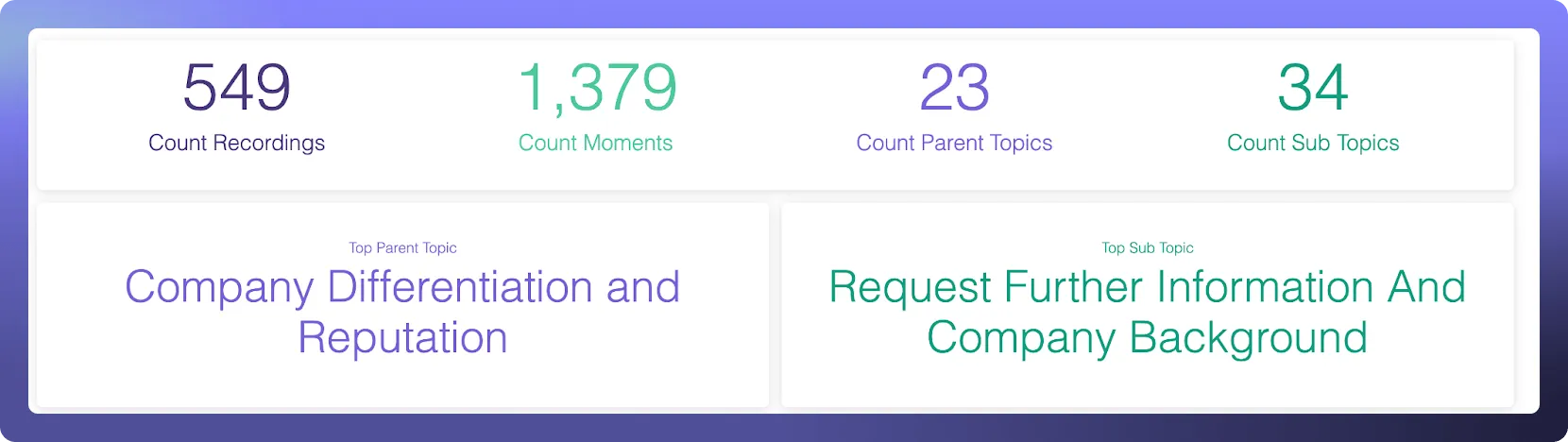
To enable consumption of this data, we have created the Knowledge Base and Conversation Insights Dashboard, offering an intuitive and interactive way to consume conversational insights.
At the top we provide a quick summary of conversation volumes and topic counts, highlighting the most frequently discussed parent and sub-topics. At a glance, you’re able to see what’s top-of-mind for your customers.
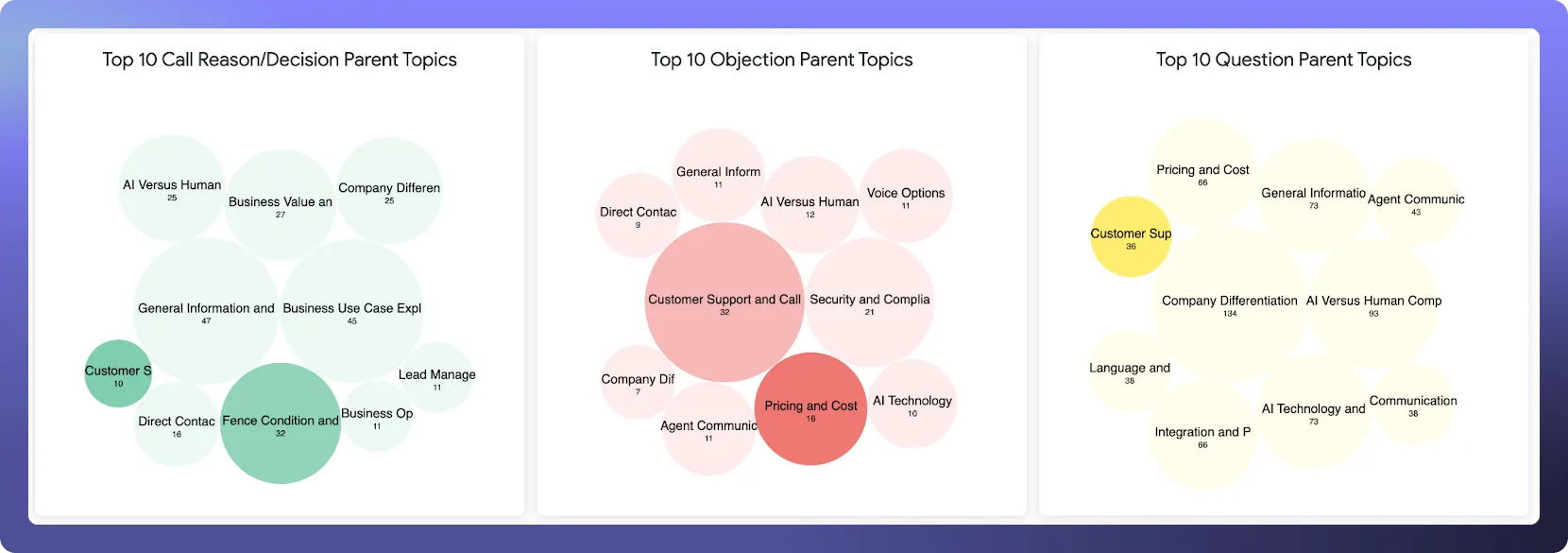
Then we use bubble charts to represent the top conversation categories, Reasons/Decisions, Objections, and Questions.
The size of each bubble shows topic prevalence, so you can clearly pinpoint prominent customer concerns or inquiries. Then, the color overlays a configurable performance metric (like transfer rate for our sales agent Reggie) to show how each conversational topic is performing relative to others.
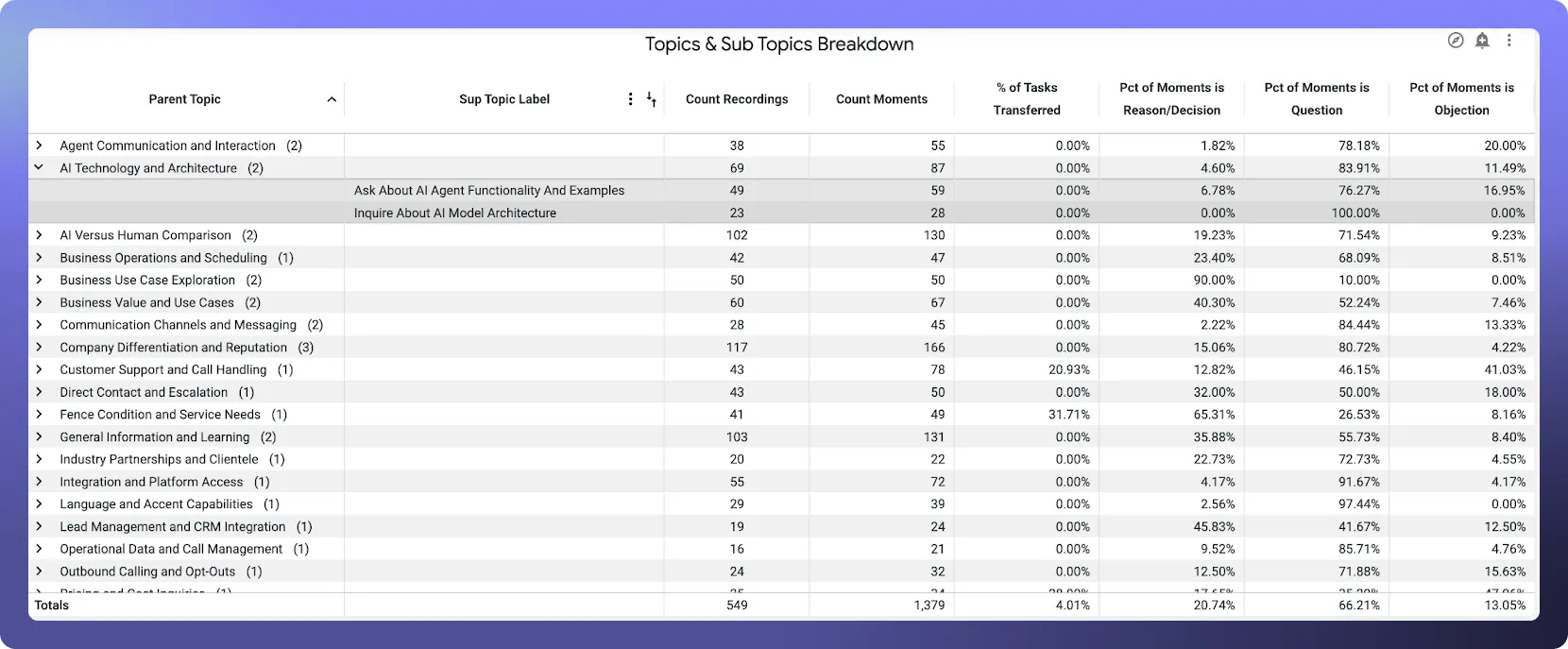
Finally, the detailed breakdown table connects topics and sub-topics with critical metrics like transfer rate, conversation counts, and type distributions (e.g., objections or questions).
With this view, you’ll know exactly what conversations to drill into first to start troubleshooting.
That could be:
Ultimately, transforming conversations into insights isn't just about understanding data, it's about truly understanding your customers and empowering your business to act with clarity and confidence.
From the image above, you might spot that “Company Differentiation and Reputation” has the highest overall volume, that 41% of “Customer Support and Call Handling” moments are objections, or that topics like “AI Technology and Architecture” are dominated by technical questions.
Each of these signals where your attention should be focused most often, and also signals different opportunities—whether that’s strengthening objection handling or expanding your knowledge base to better cover high-interest areas.
One of the most compelling advantages of embedding conversational moments is enabling semantic search across an entire set of interactions.
For example, in a dashboard you search: "frustrated about long wait times." The query is passed through the same embedding model, transforming it into a vector.
We then search for the closest vectors in our database of conversation embeddings, surfacing the most semantically similar moments, even if the customer never used the exact phrase “long wait.”
This allows you to instantly:
Whether you want to find examples of people who are ready to convert, expressing confusion, or strongly objecting, you can now find them with natural language queries.
Another powerful application of semantic embeddings is evaluating how effectively an AI agent's knowledge base covers frequently discussed customer topics.
For example, if many customers inquire about integrating with a CRM, but few similar embeddings appear in the knowledge base, this signals an actionable gap, which could prompt updates or expansions to agent knowledge databases.
Embedding and clustering customer conversations also allows you to track net new clusters and analyze shifts in embedding patterns over time.
This makes it possible to detect shifts in customer interest or concerns at an early stage.
For instance, if a new cluster of inquiries around AI ethics or data privacy emerges, you can quickly create relevant Knowledge Base content or adjust AI Agent prompts to address these concerns head-on, before they become widespread issues.
The challenge we started with was clear… Massive volumes of AI-handled conversations are filled with valuable customer signals that are buried in unstructured transcripts too large to review manually.
With Regal, every interaction becomes structured, enriched, and transformed into a format machines can understand, without losing the nuance humans need to gain insights and optimize AI agent performance.
By bridging raw language and actionable data, you move from guesswork to precision, from missed opportunities to targeted improvements.
The result is what we and every enterprise hopes to gain with AI: faster insight, smarter decisions, and customer interactions that keep getting better.


Apple’s iOS 26 introduces new call-screening controls that will reshape outbound performance. This guide explains what’s changing, how adoption may impact enterprise contact centers, and the proactive steps leaders can take now to protect answer rates and customer trust.
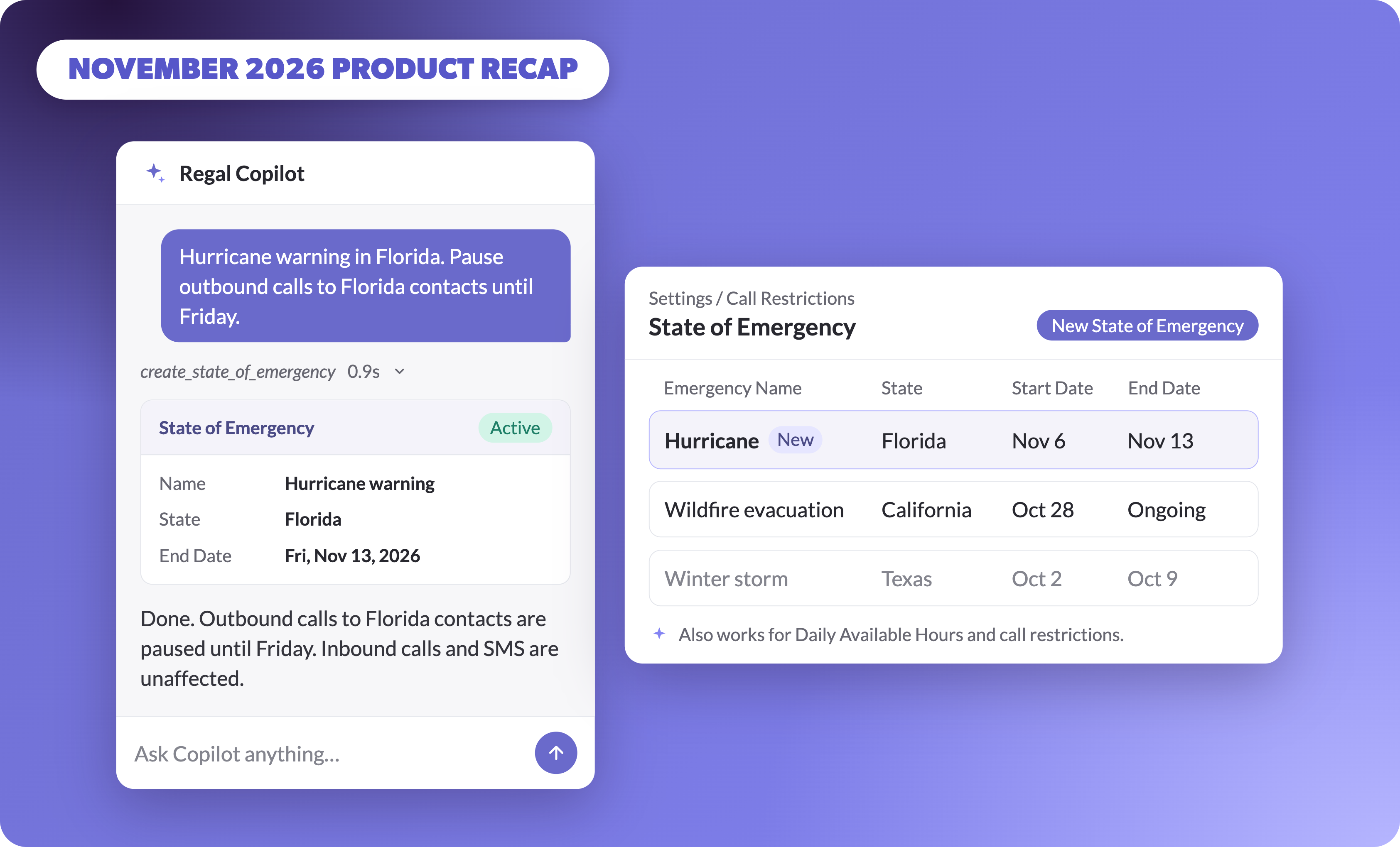
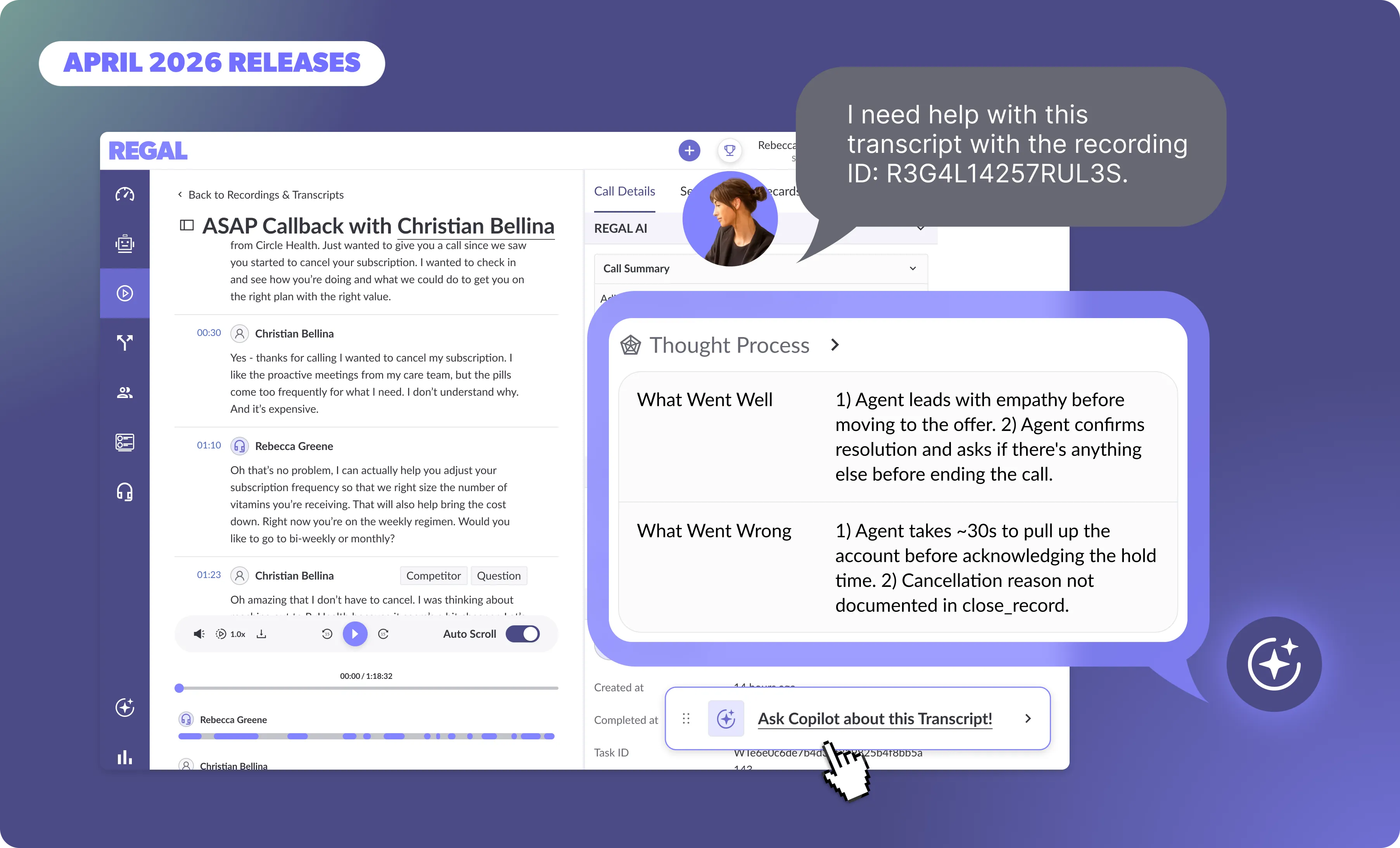
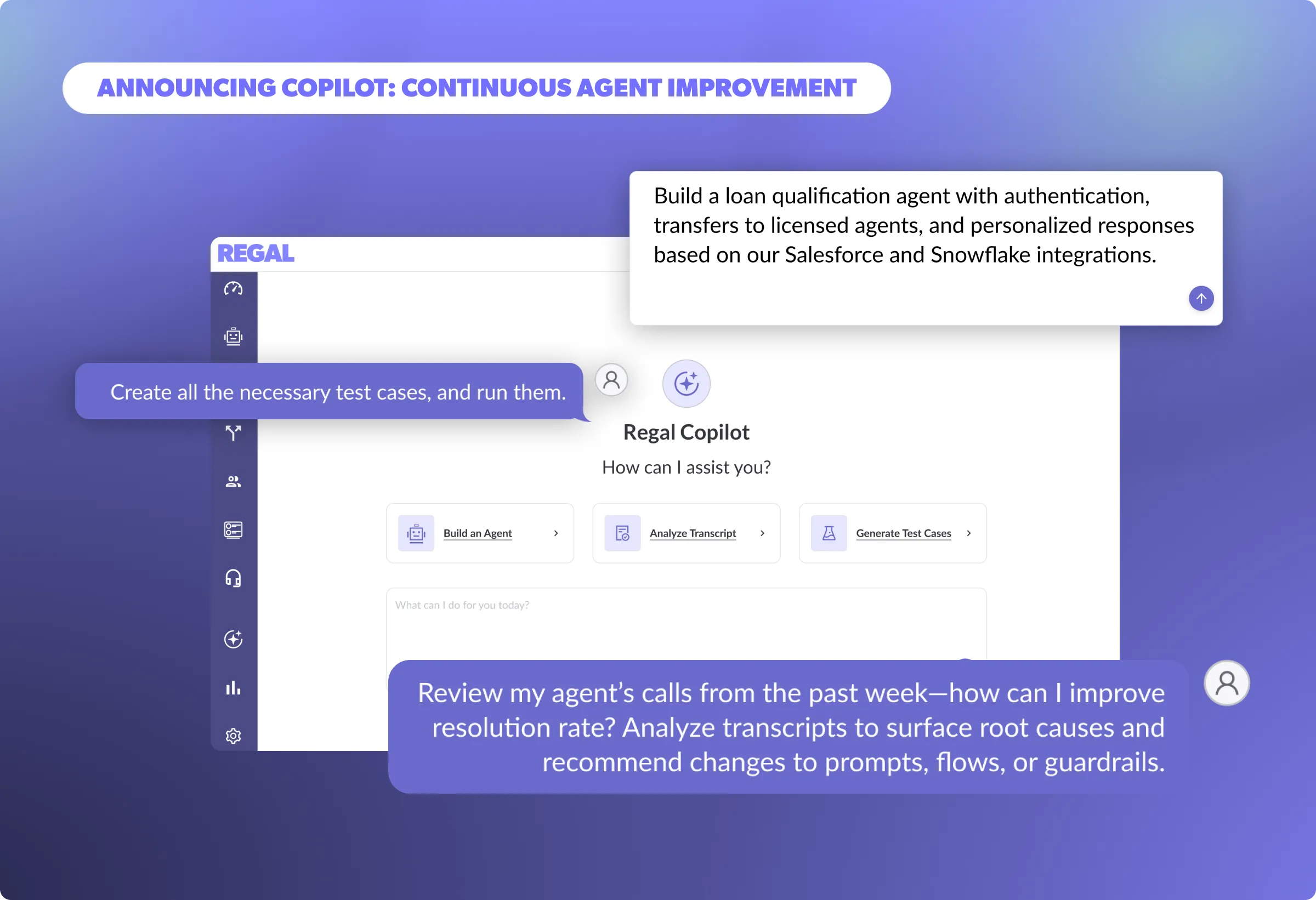
This month, we released features that make multi-state agents more goal oriented and easier to build, test, and monitor. We're also expanding our developer tools with Regal Functions, so you can write and host code right alongside your agents, plus new Public API endpoints.
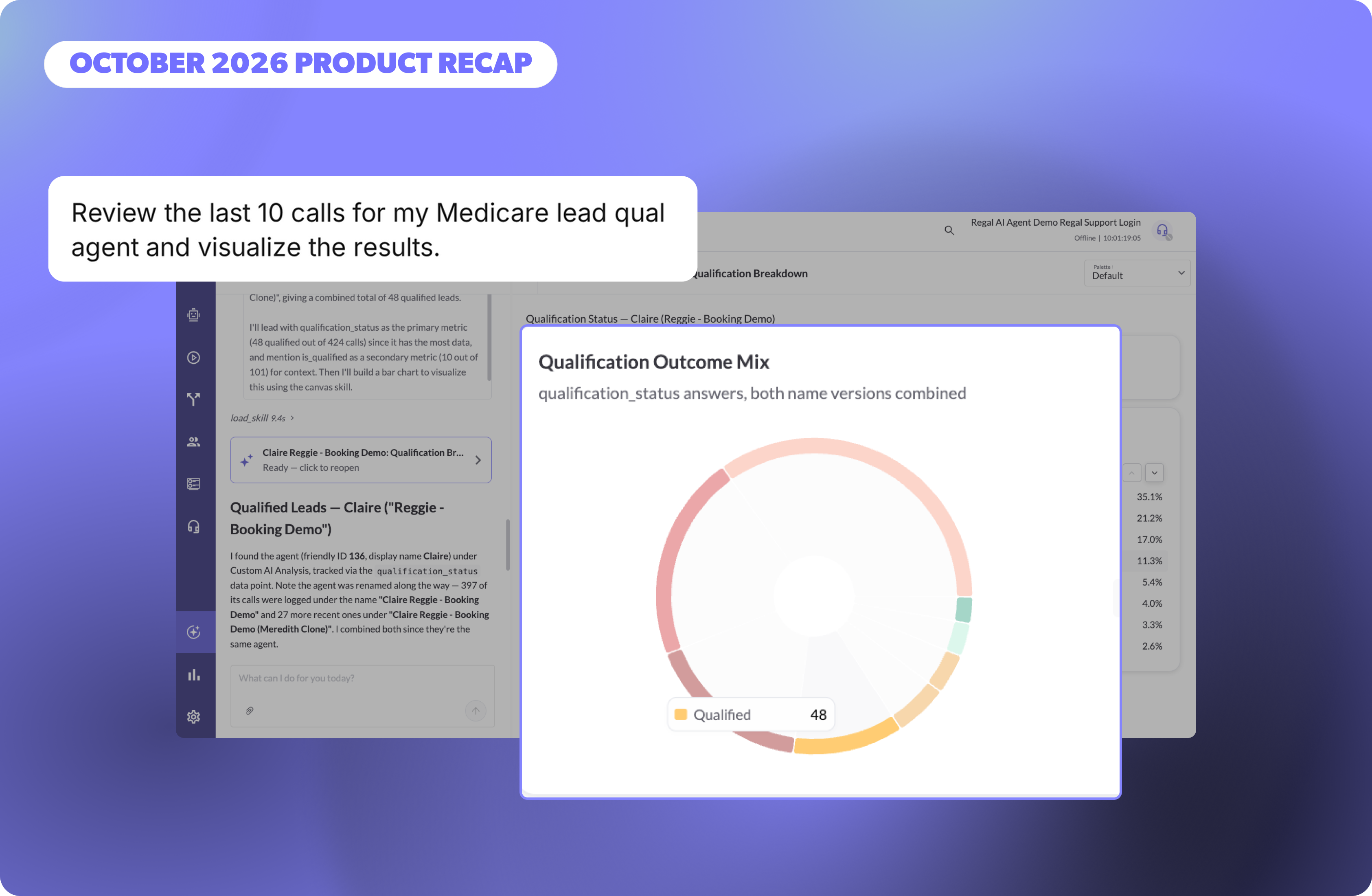
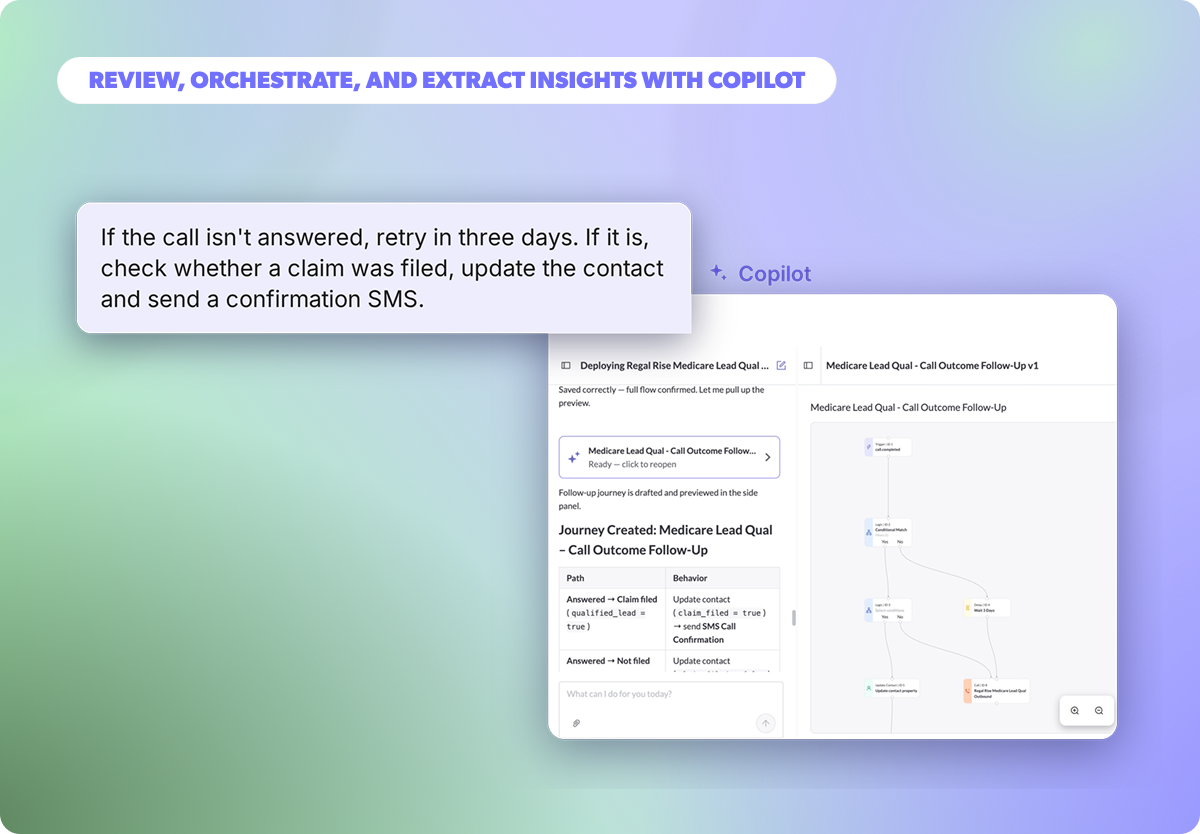
Last month, we shipped releases that improve your contact center operations by extracting business insights with Copilot and reducing wasted agent minutes with our new Voicemail Detection model. The result is more reliable, productive AI agents that can drive revenue for your business.
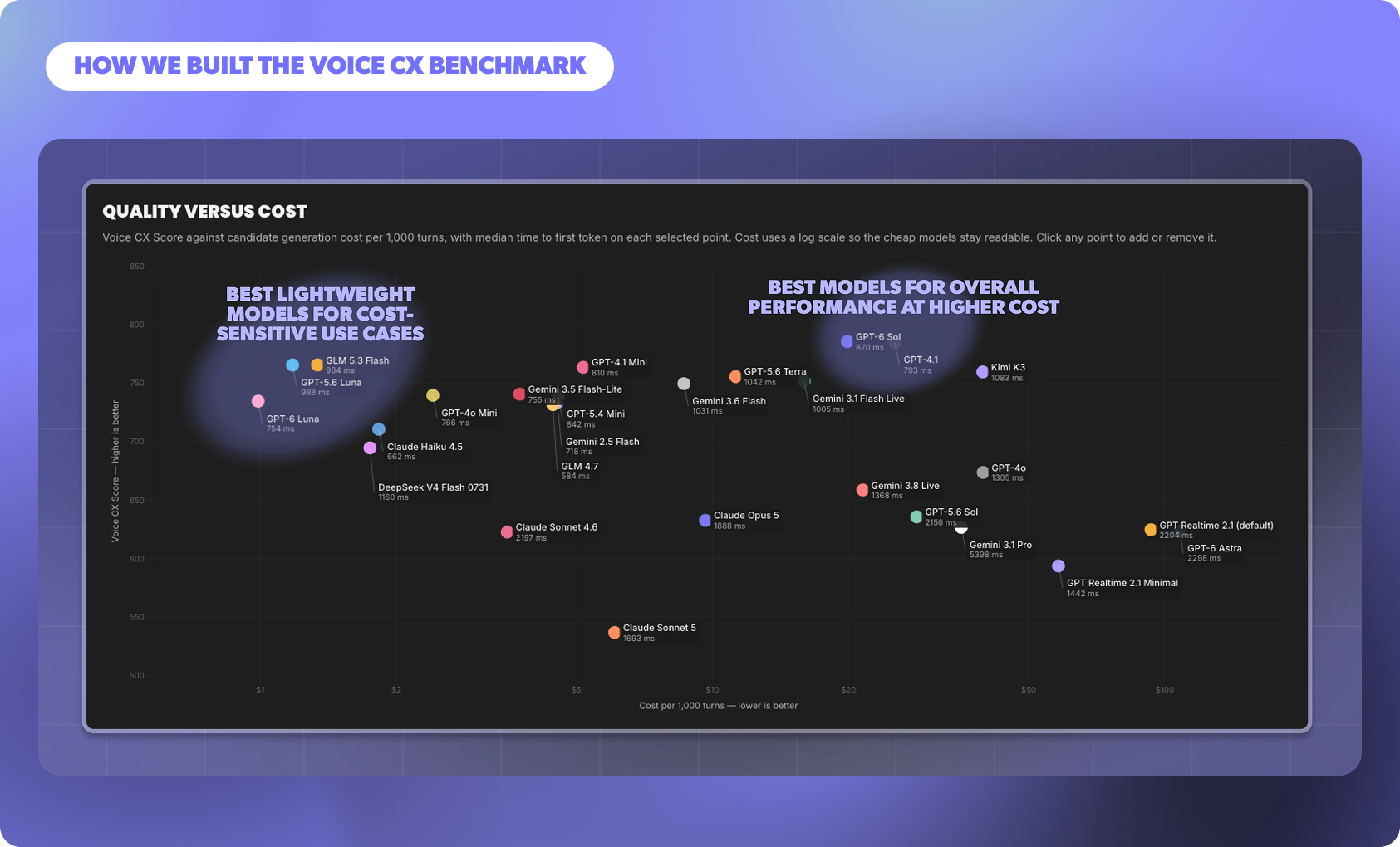
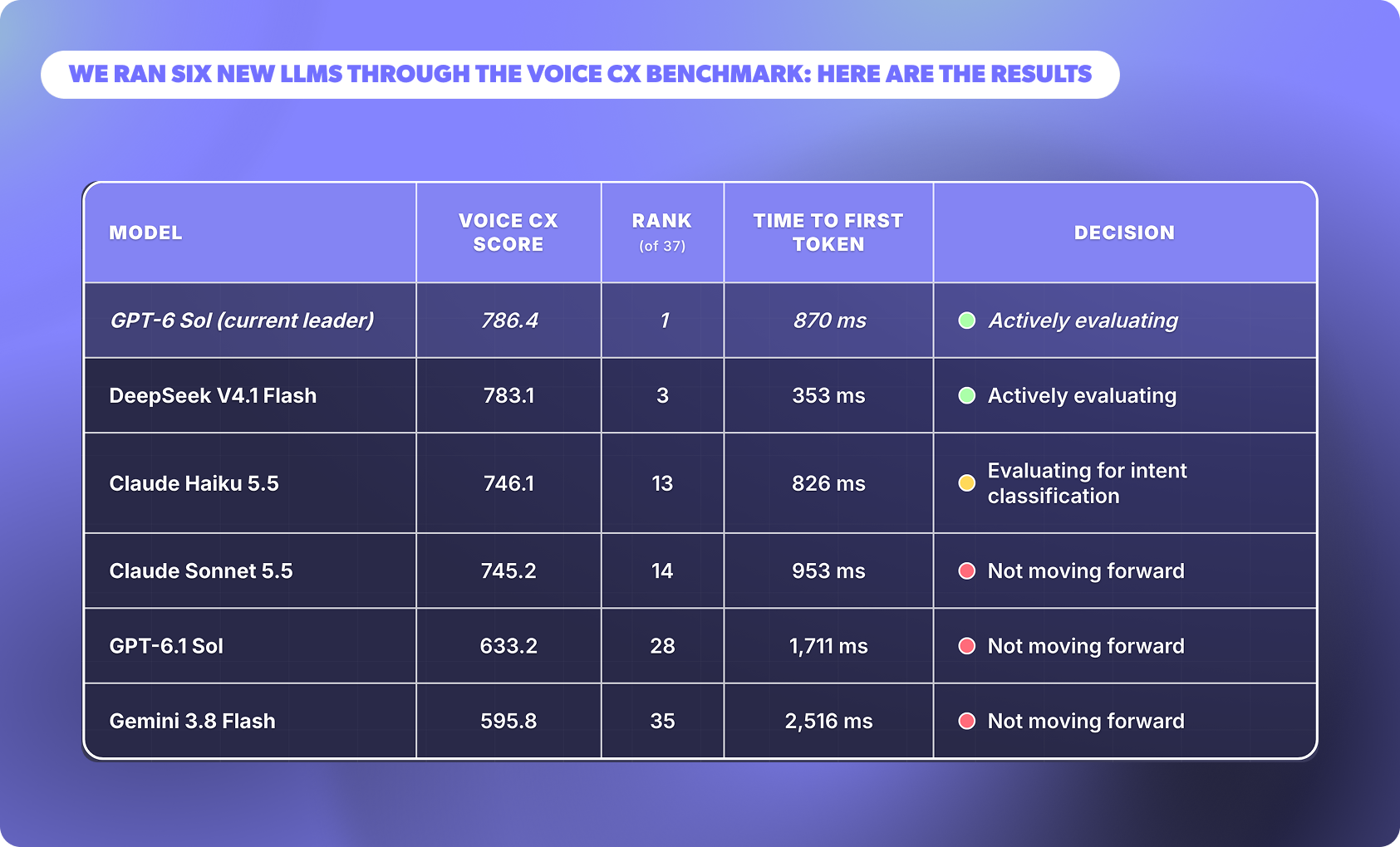
Enterprises need voice agents that hold a natural, human-like conversation while moving each call toward its goal and staying within compliance boundaries. The Voice CX Benchmark scores models on exactly that: how well they progress the call turn by turn, how safely and clearly they communicate, and how quickly they respond.
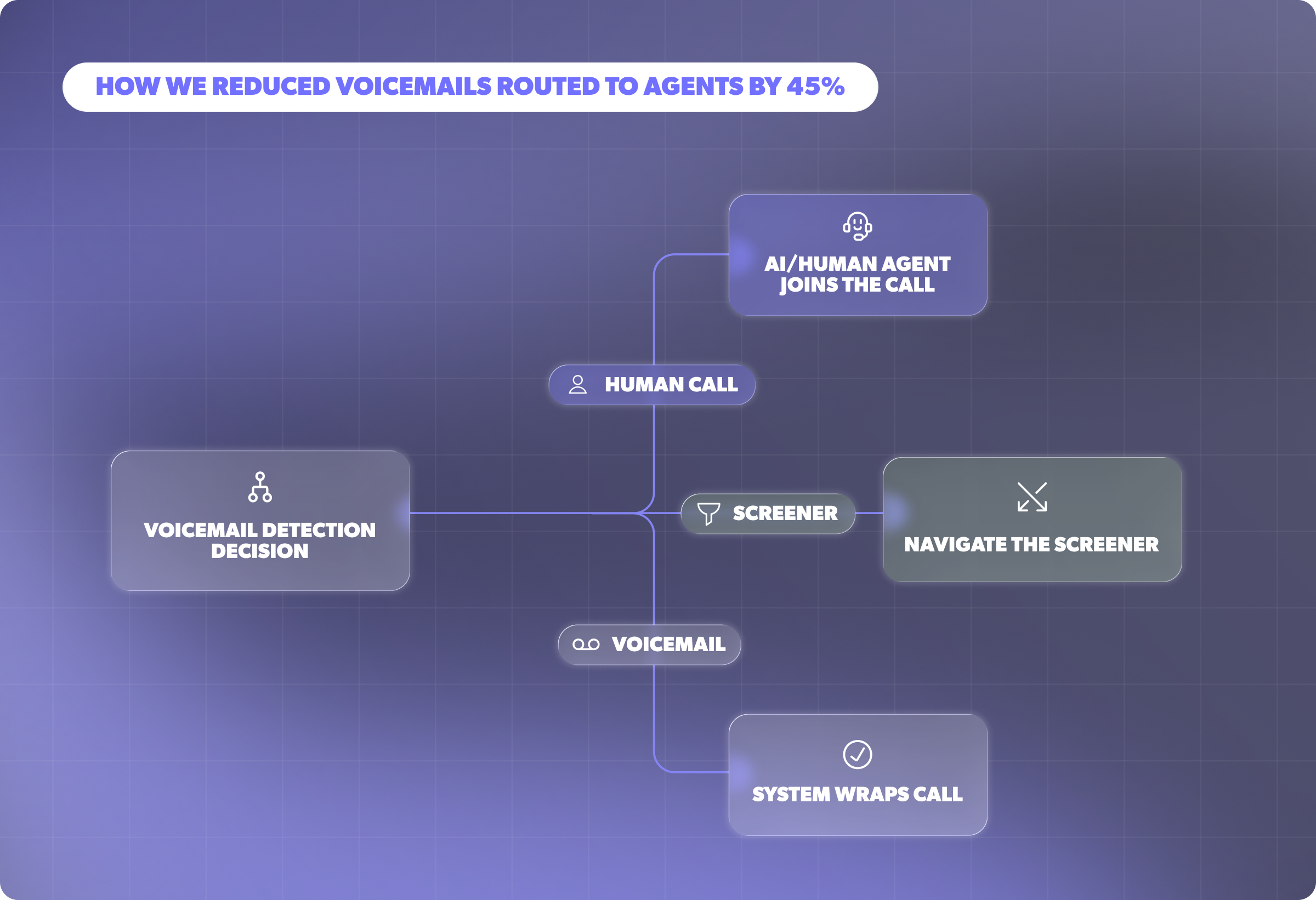
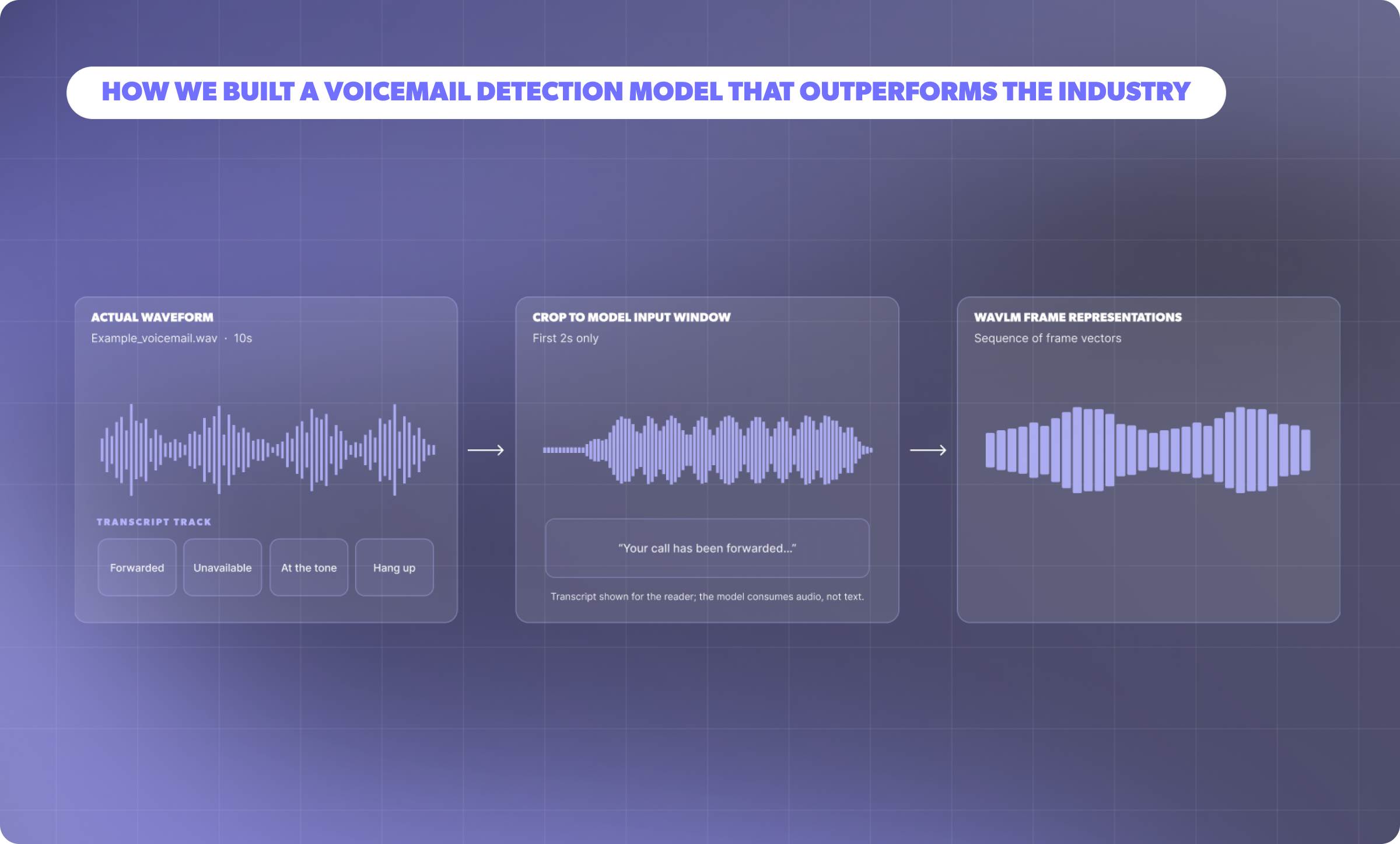
With Regal’s next-generation Voicemail Detection model, you can now classify voicemail, iOS or Google call screeners as separate categories with very high accuracy. This enables screener-specific handling, ultimately reducing missed agent connections.
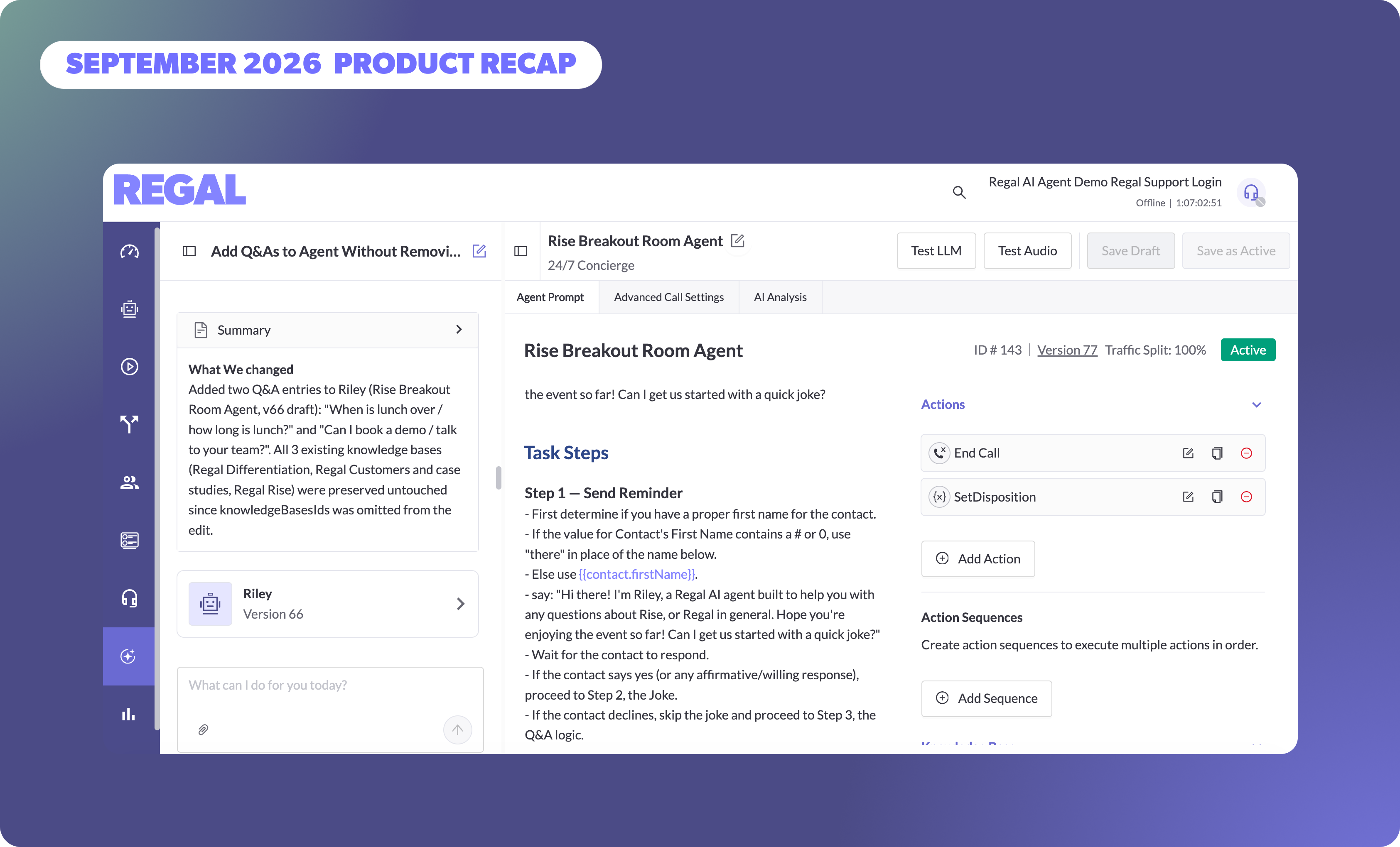
Last month, we shipped releases that make it easier to build, monitor, and test agents in one interface. Copilot Canvas brings building, editing, and testing into one interface and it can work straight from your files. Multi-state sticky notes let your team document decisions directly on a live agent.
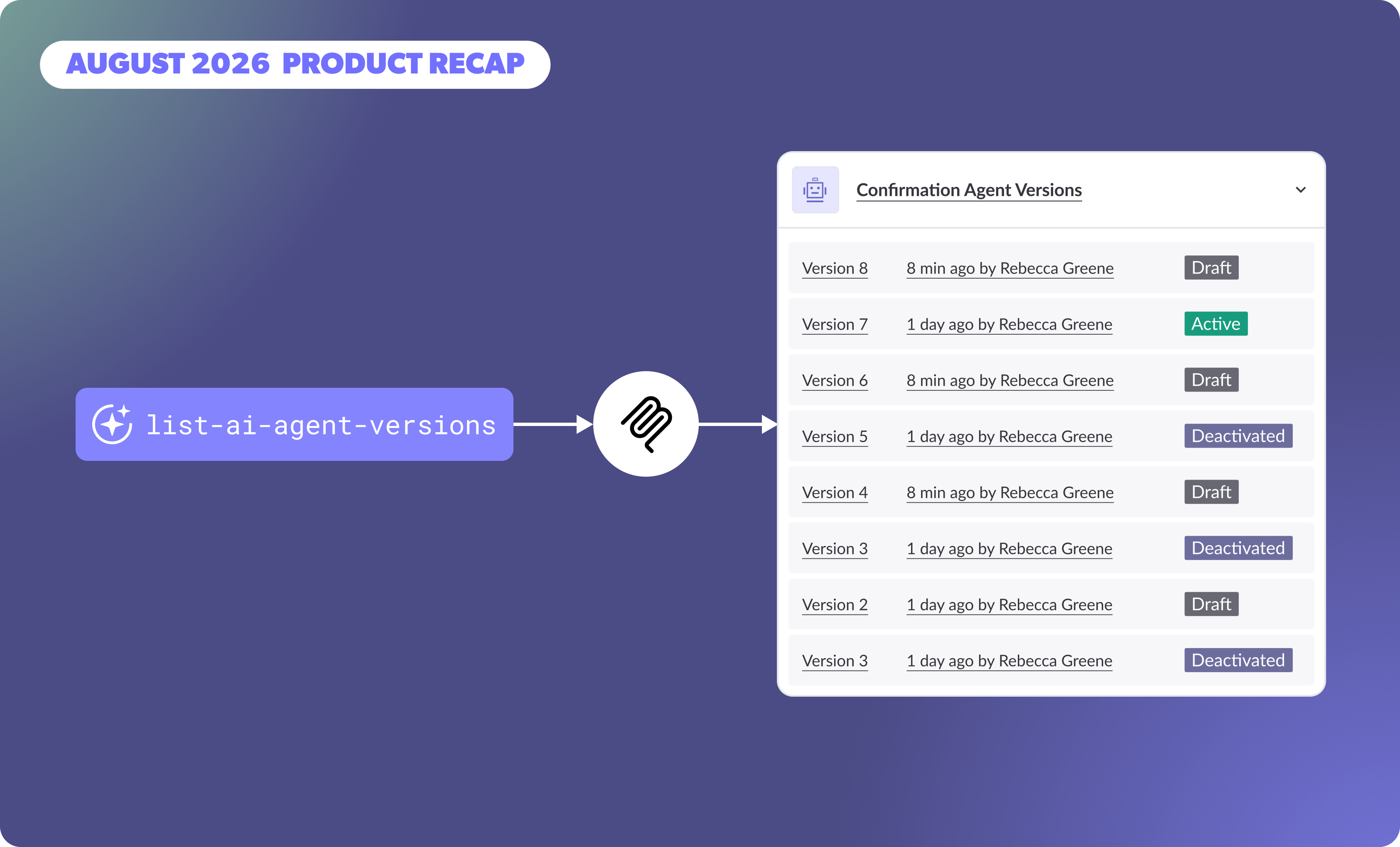
Last month, we launched features that extend your management of AI agents via MCP and CCaaS platforms. Debug based on agent versions or simulation runs, and manage AI analysis data points via Copilot and Regal MCP. As a Five9 AI Agent Connect partner, Regal now has a dedicated integration API built for Voice AI agents.
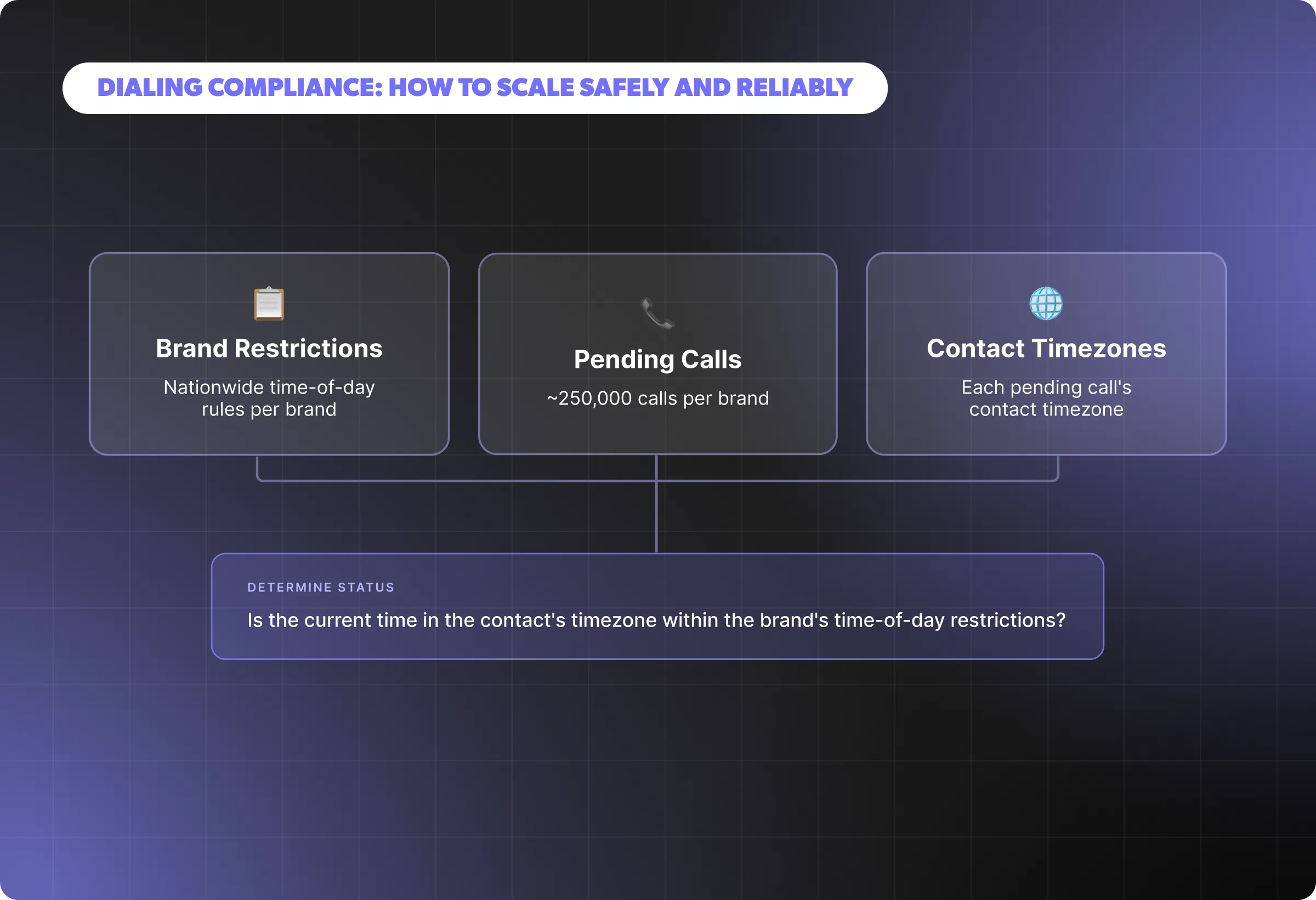
Behind a fragmented and ever-changing regulatory landscape is a simple goal: protecting people from unwanted or poorly timed outreach and giving them control over how they’re contacted. In practice, that responsibility translates into a set of checks that must be validated.
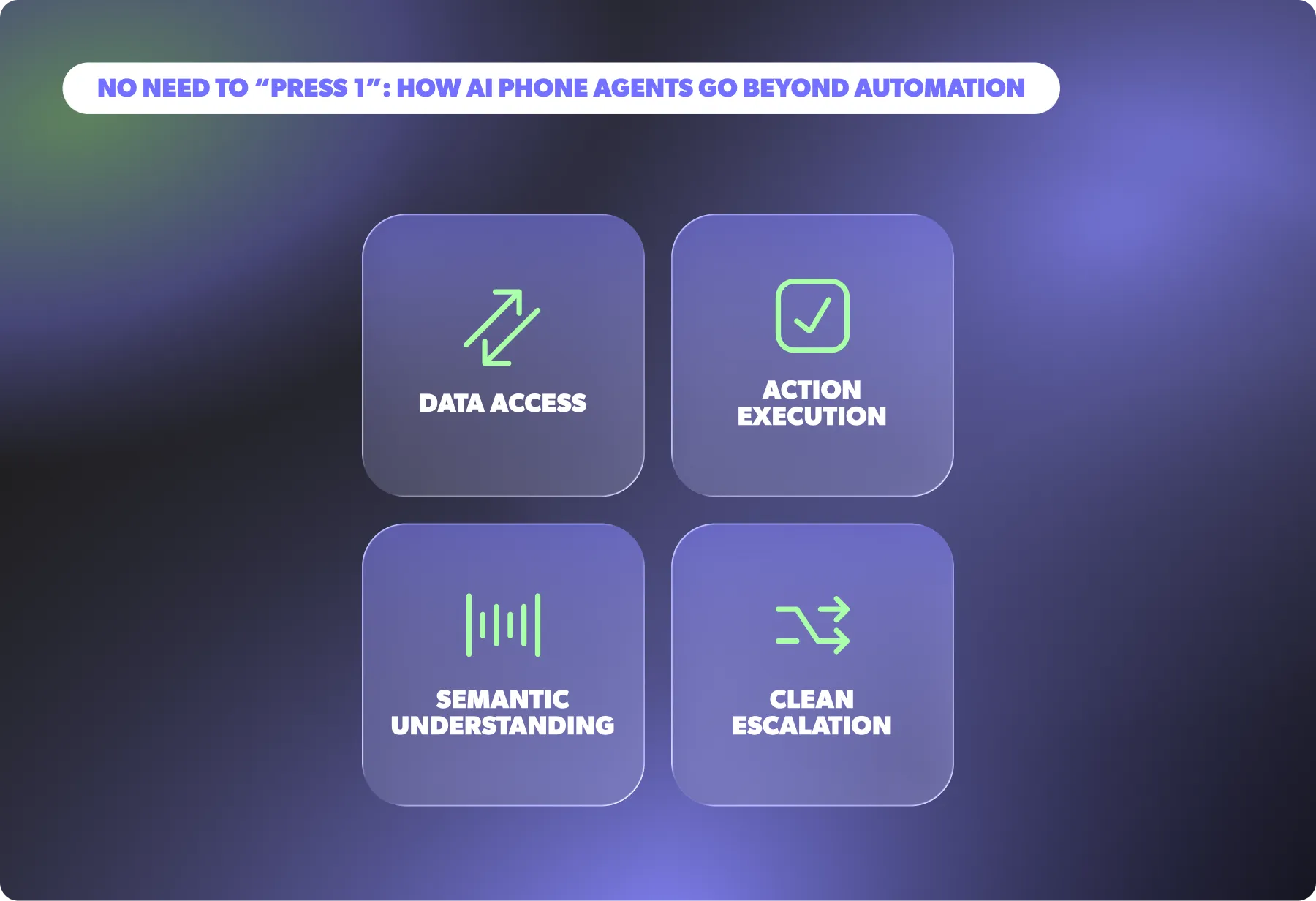
AI phone agents aren't just better phone trees. They are autonomous systems that can understand caller intent, retrieve relevant information from your CRM in real time, execute actions, handle objections and clarifications, and complete the conversation without human involvement.
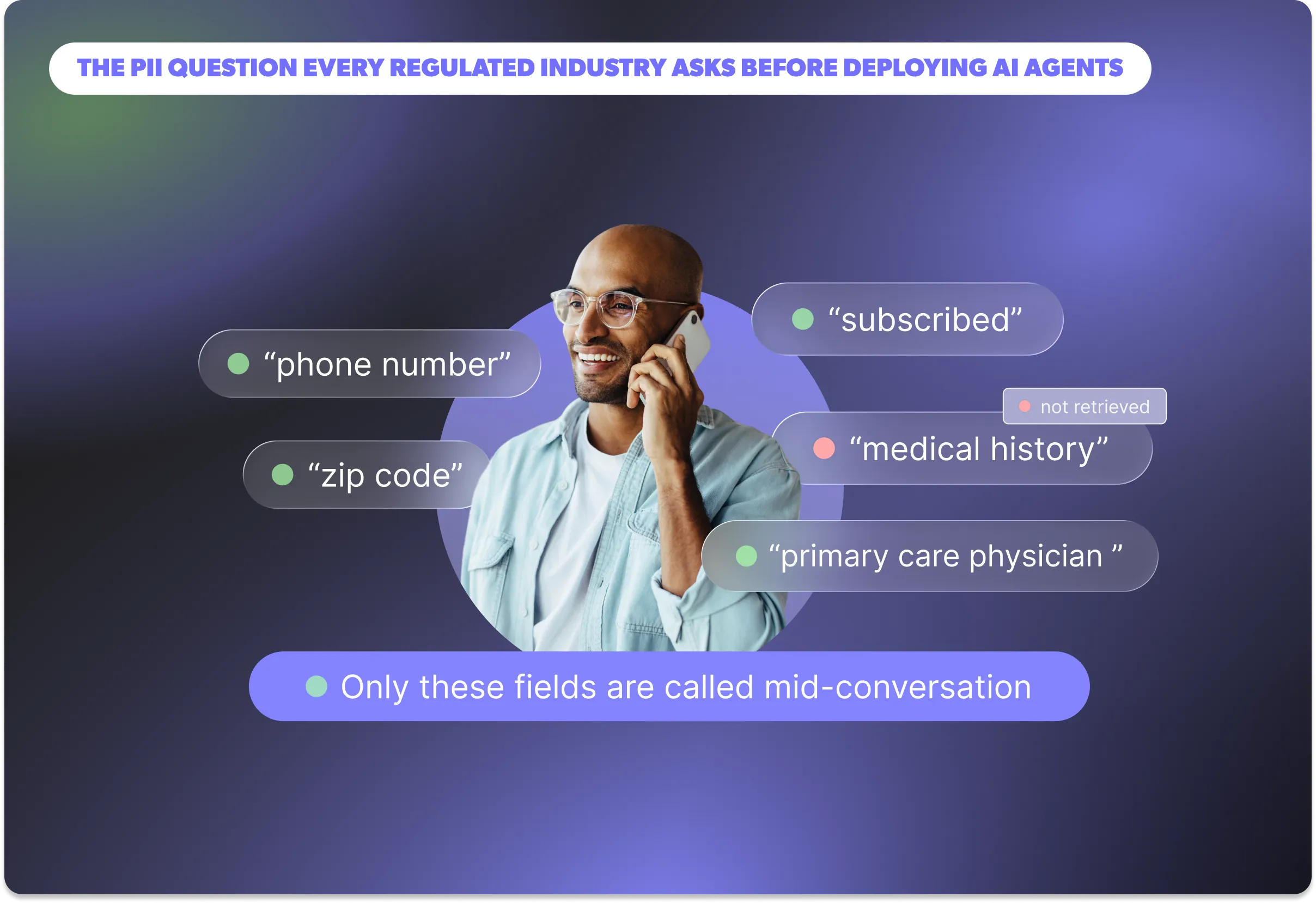
When prospects in healthcare and financial services hear "PII," they often imagine bulk data transfer: the idea that deploying an AI agent means copying a database somewhere. In most modern deployments, that's not what's happening.
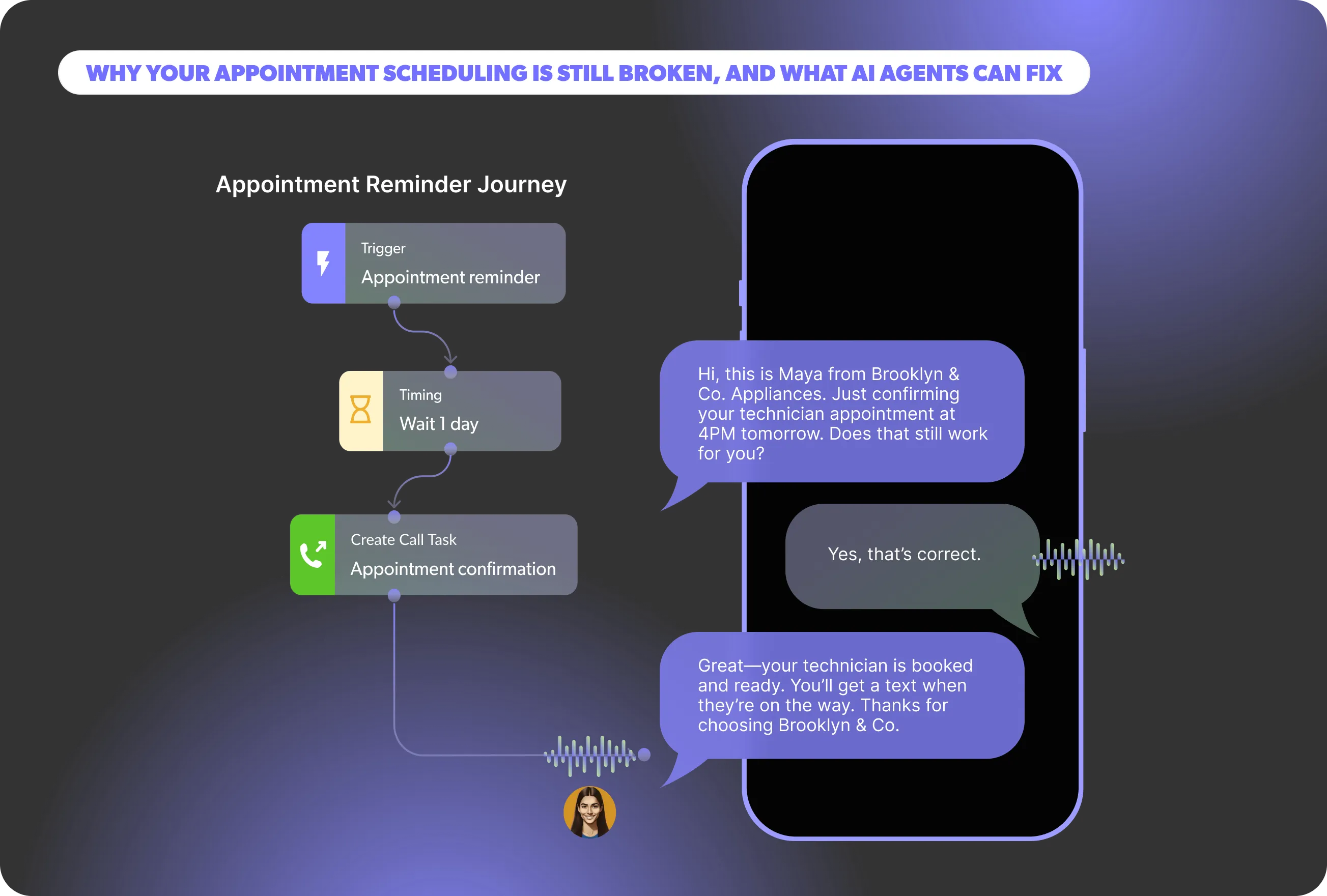
With AI agents, every appointment gets a confirmation call. Each contact gets a chance to reschedule, and the confirmation rate goes to 100%, not because the AI is better at conversations than your agents, but because the AI never runs out of capacity.
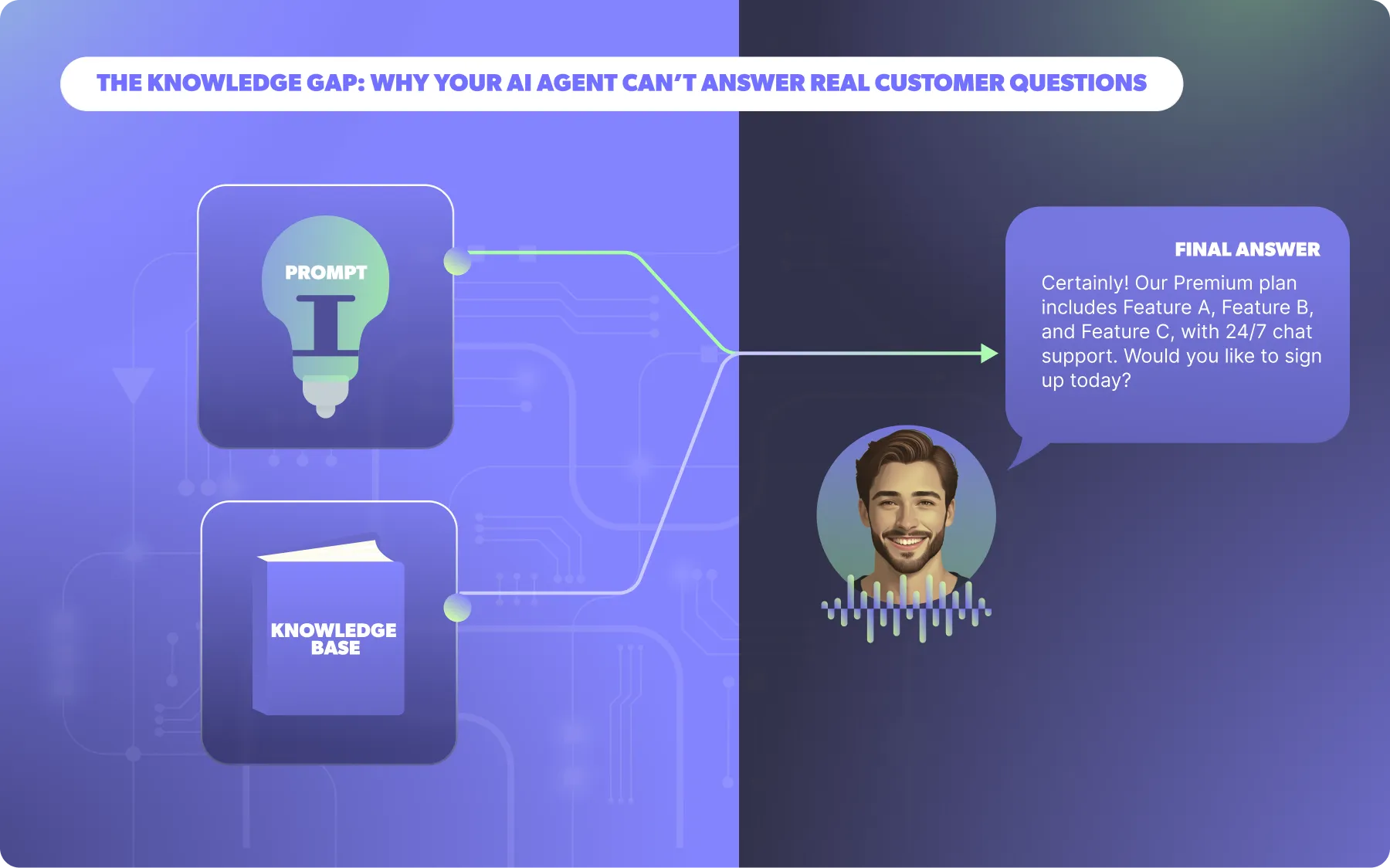
AI agent performance depends on how well it aligns with real customer language, not just fluency. Regal Improve helps teams identify gaps and improve outcomes by analyzing real conversations and surfacing high-impact opportunities
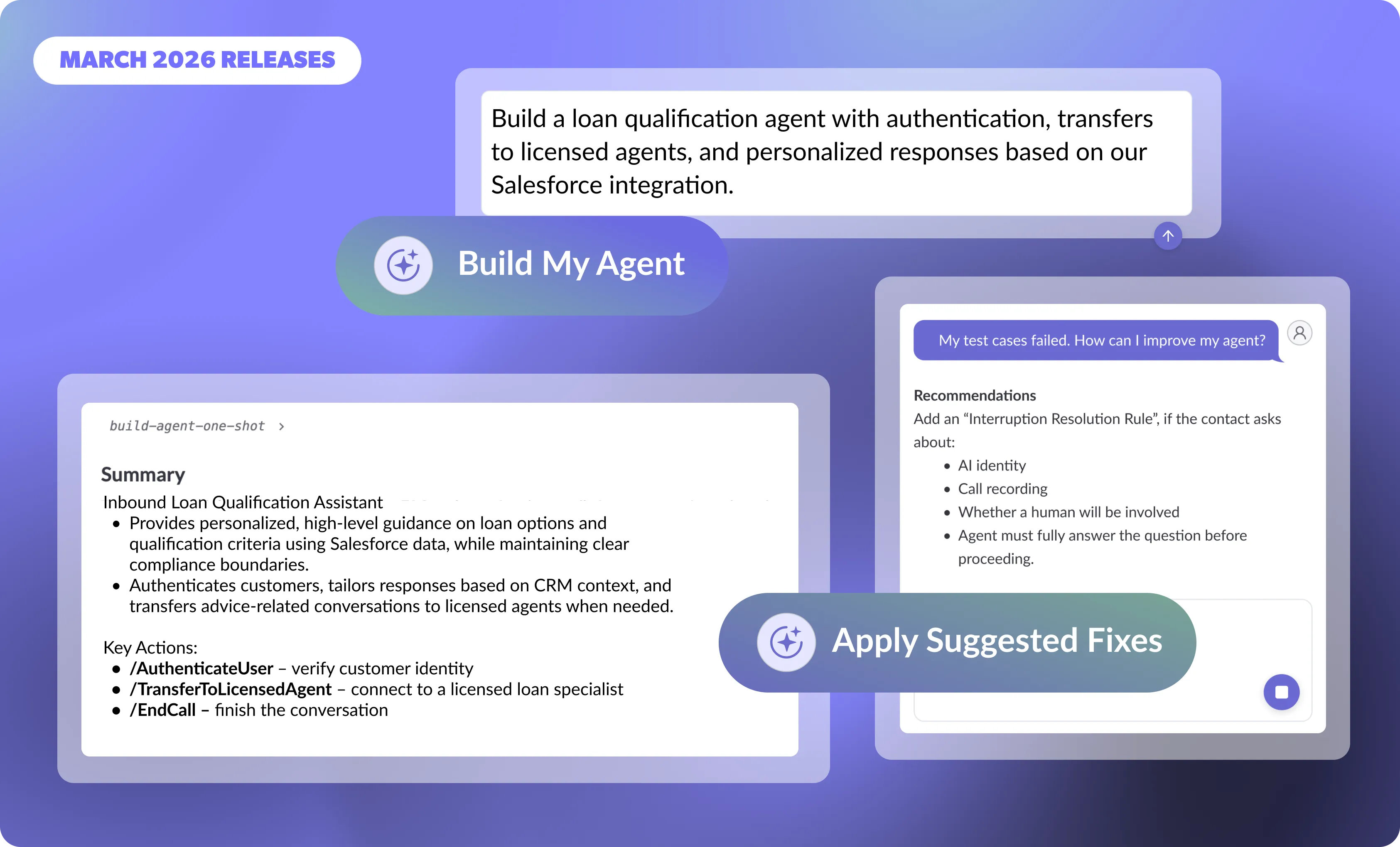
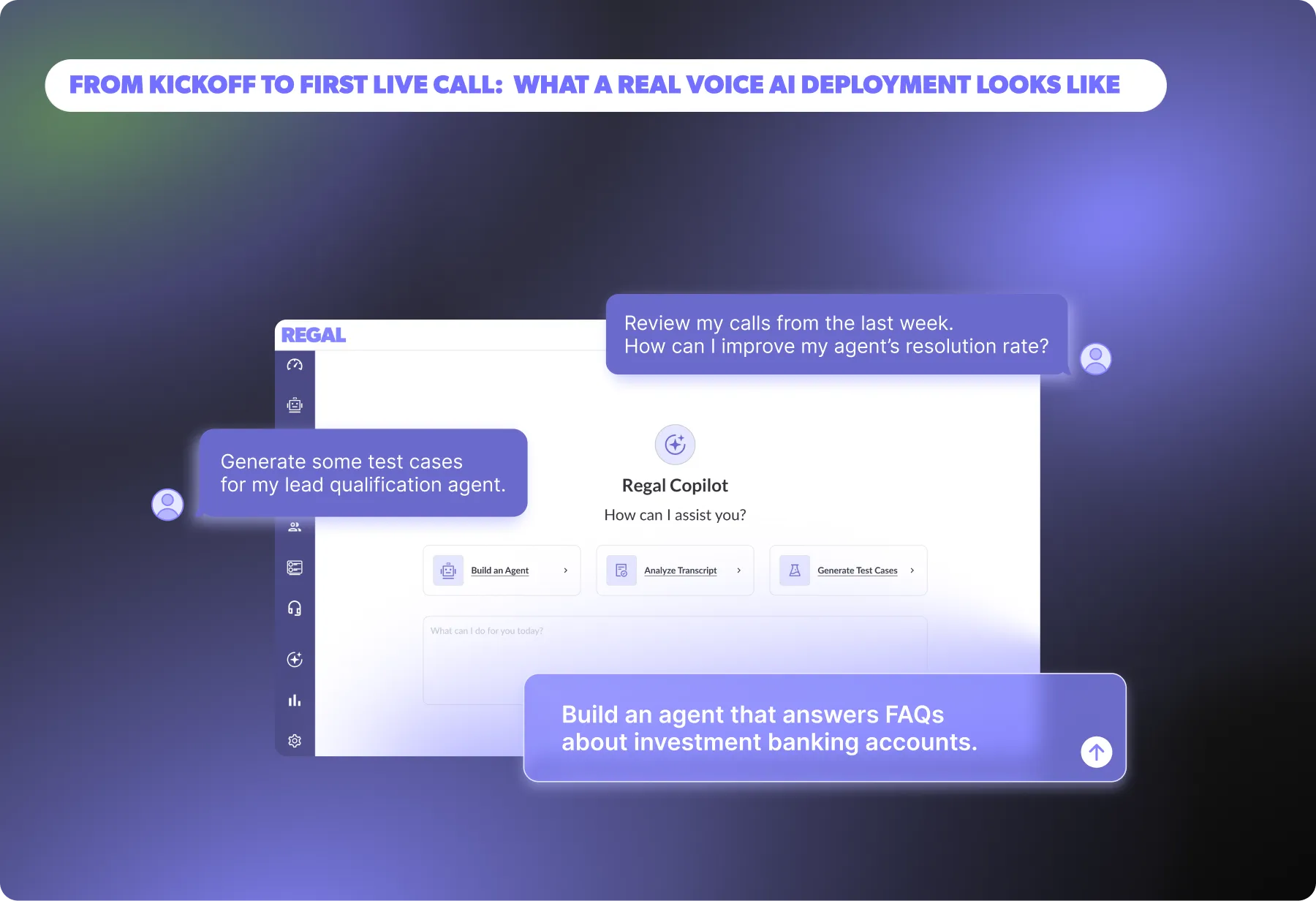
In March, we made it faster than ever to build, launch, and continuously improve AI agents with Copilot, Regal's AI agent for building AI agents. Together, these updates lessen the time needed to launch and maintain agents, so you can focus on understanding your customers, unlocking new use cases, and driving faster business outcomes.
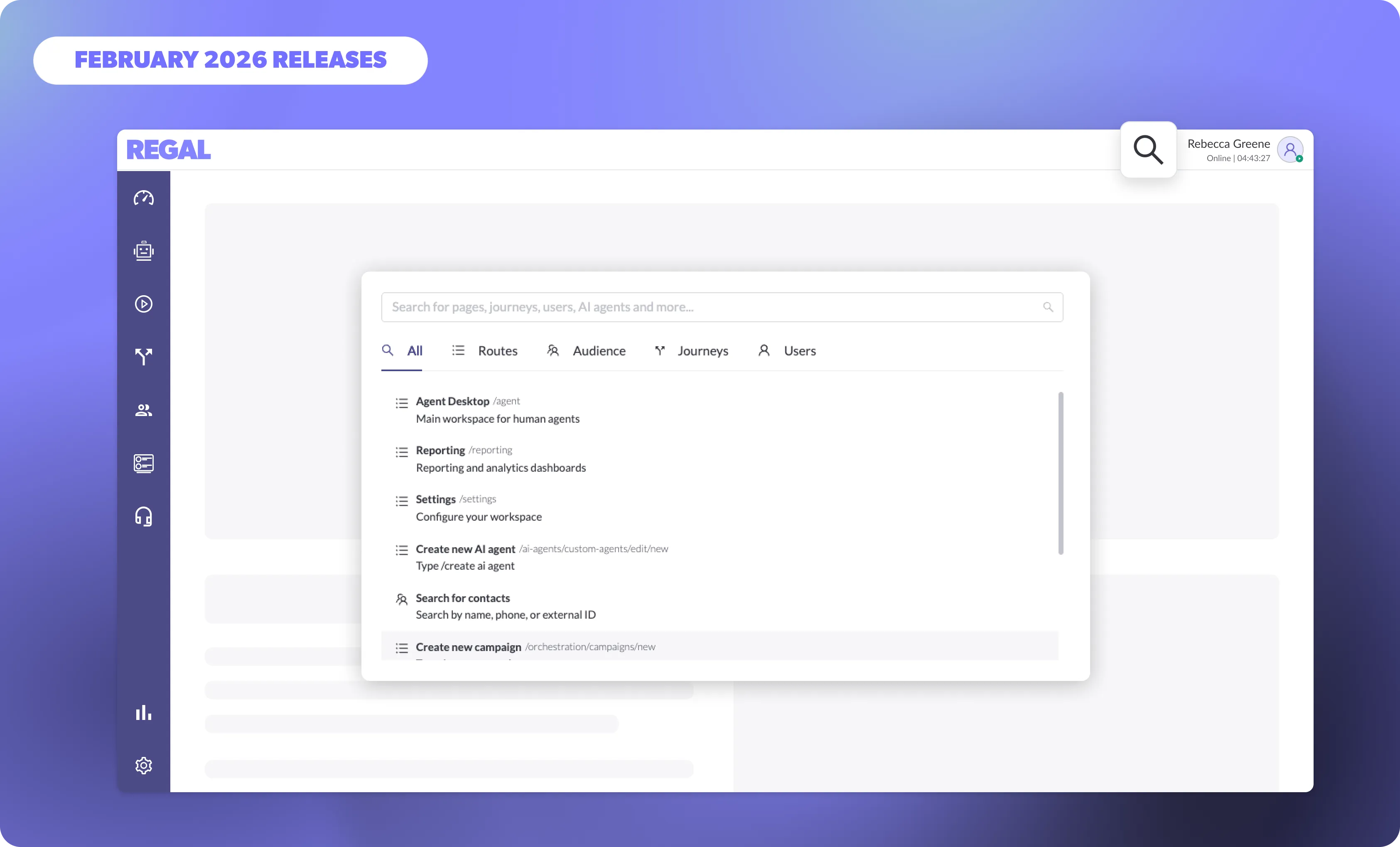
In February, we made AI agents sound and feel more natural, even when handling complex, multi-step conversations with conditional logic. These updates give you the control to build AI agents that don't just follow a script: they adapt, respond, and engage naturally with each customer.
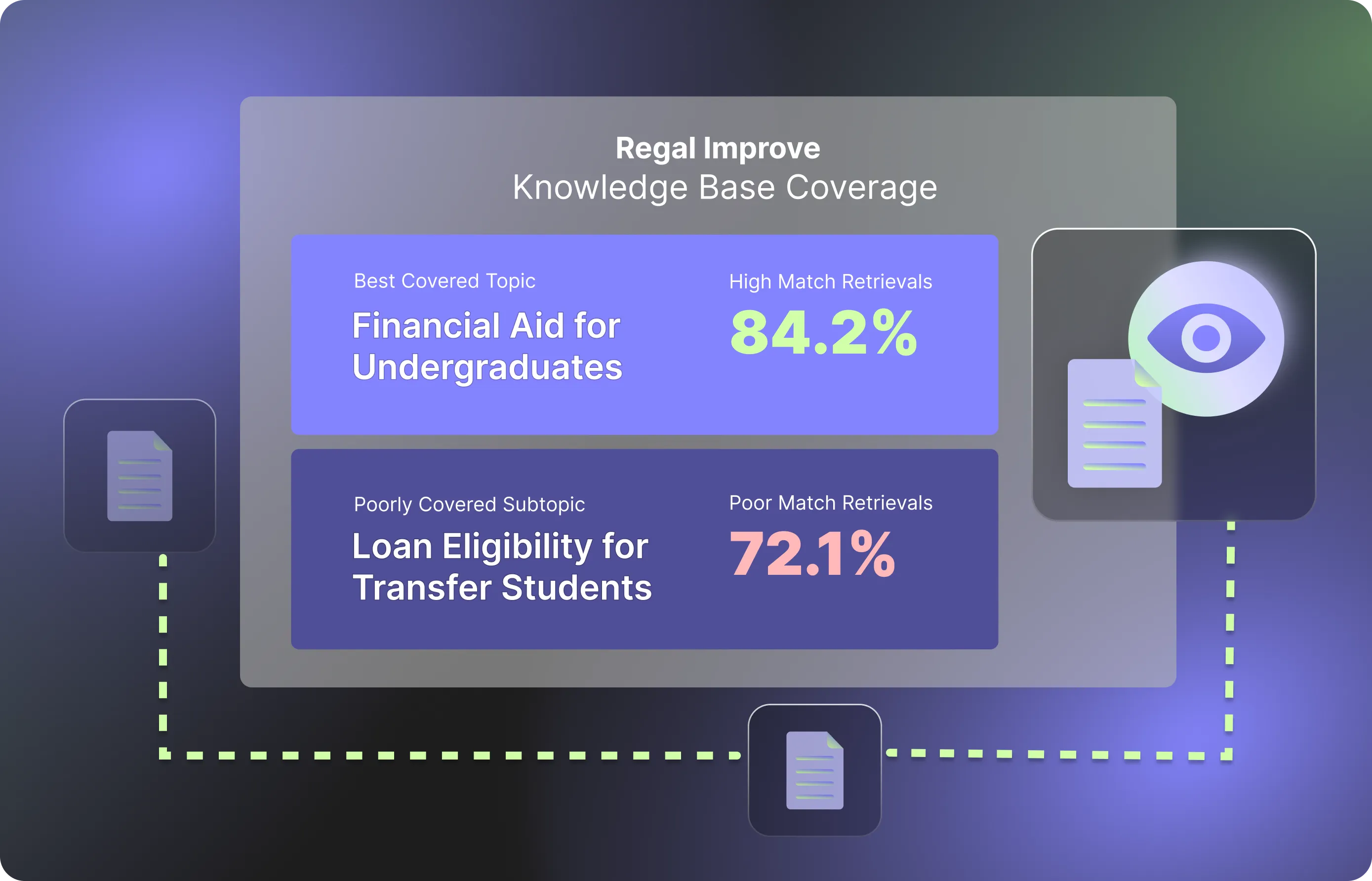
Customer conversations are inherently dynamic, and Regal Improve’s Knowledge Base Coverage tracks changes in retrieval performance over time and at scale. This makes it easy to verify that KB updates increase coverage and if your documentation is keeping up with evolving customer requests.
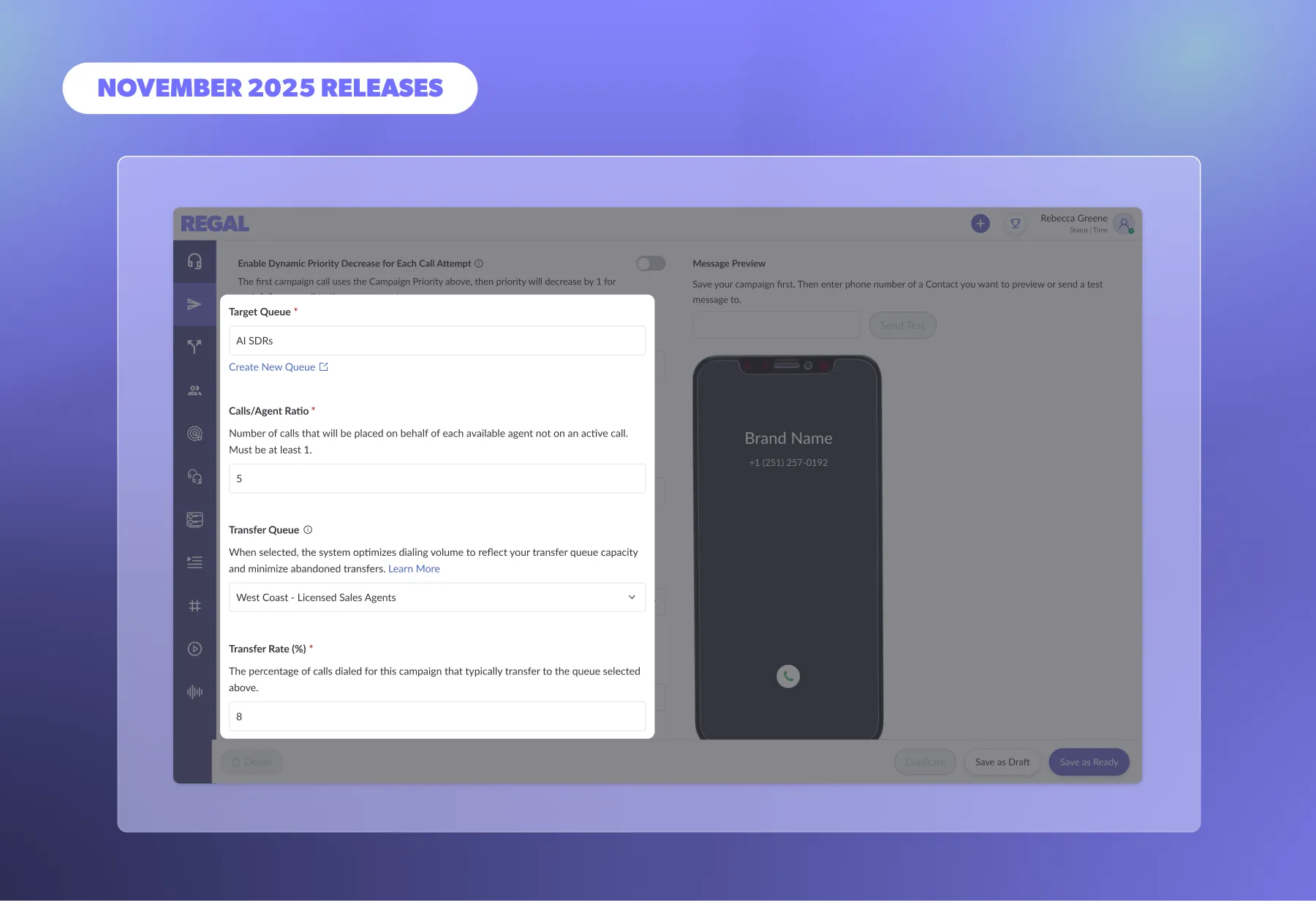
November's releases make it easier to scale your transfer-heavy call flows, with new tools that align dialer pacing to downstream agent capacity and streamline complex handoffs. You’ll also see improved post-call workflow accuracy, with reliable data extraction and disposition outcomes driven by LLM configurability and earlier validation.
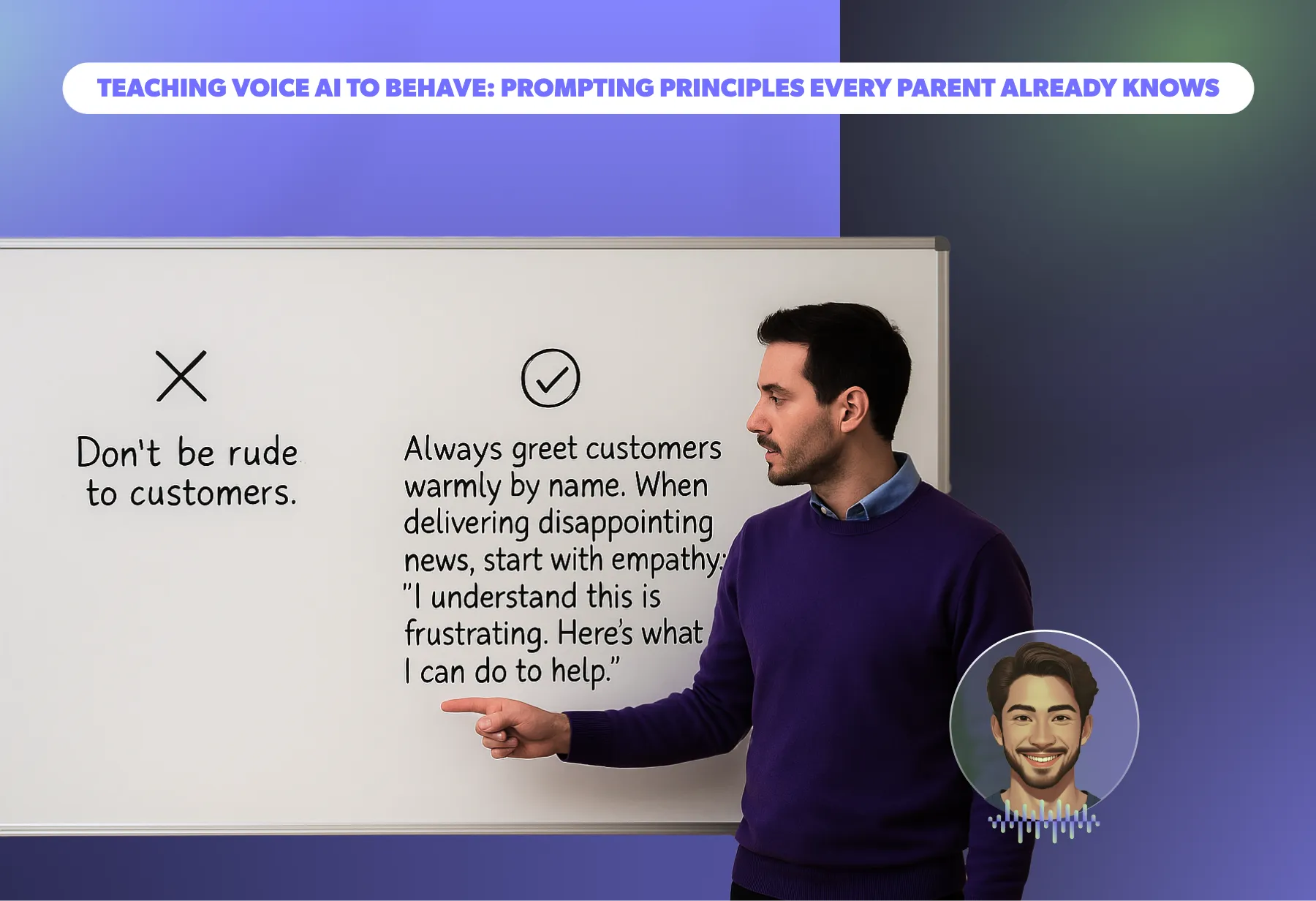
Building a great AI voice agent isn’t so different from parenting a five-year-old: clarity, examples, and structure make all the difference. This post breaks down proven prompting principles—from positive framing and persona design to conversational guardrails—that help AI agents sound natural, stay on task, and follow directions every time.
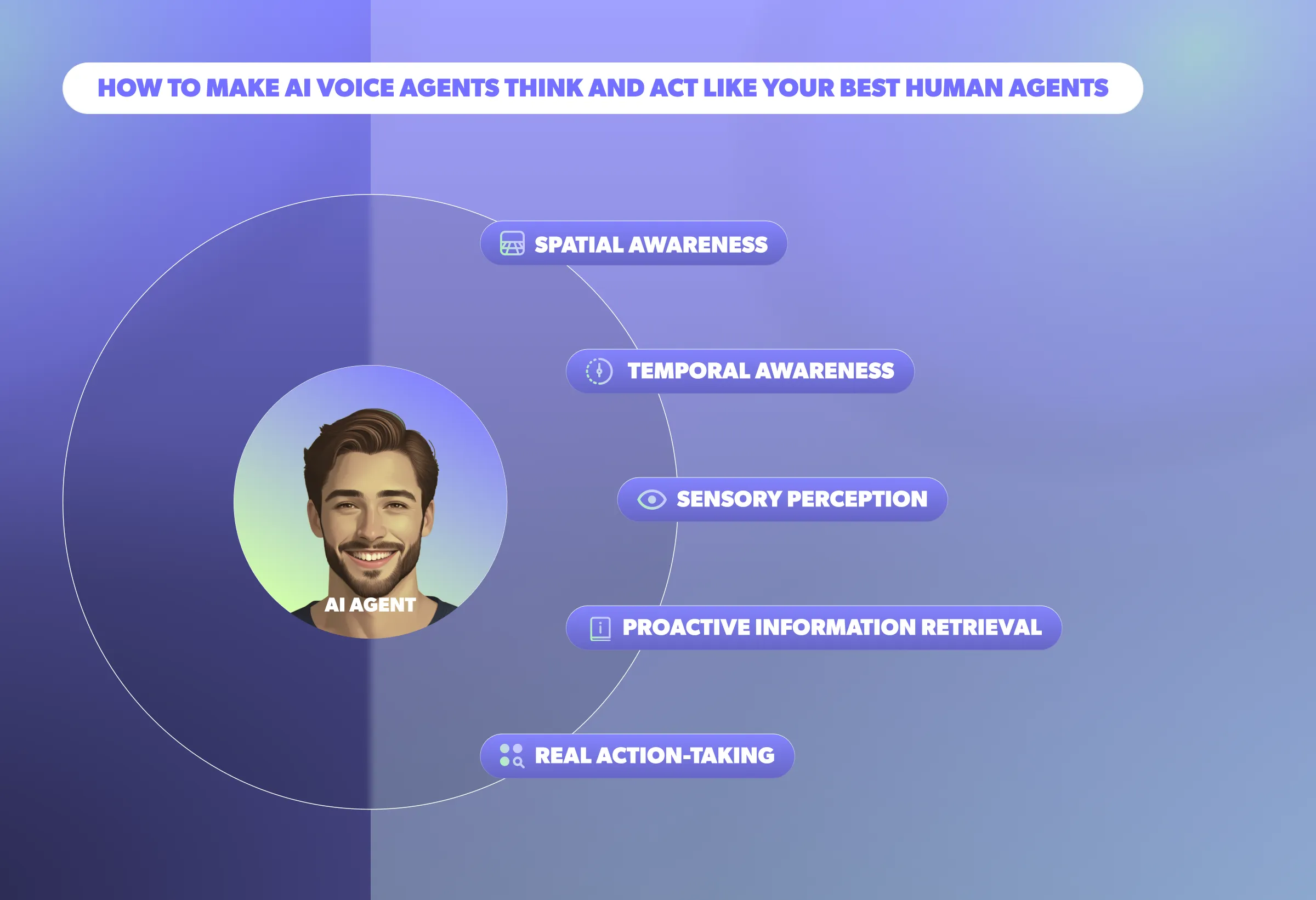
See how modern AI voice agents can match your best human reps by building five core capabilities into every call: spatial awareness, temporal awareness, sensory perception, proactive retrieval, and real action-taking. This post breaks down what each pillar means in practice and how they turn voice AI from a conversational bot into a fully empowered operator.
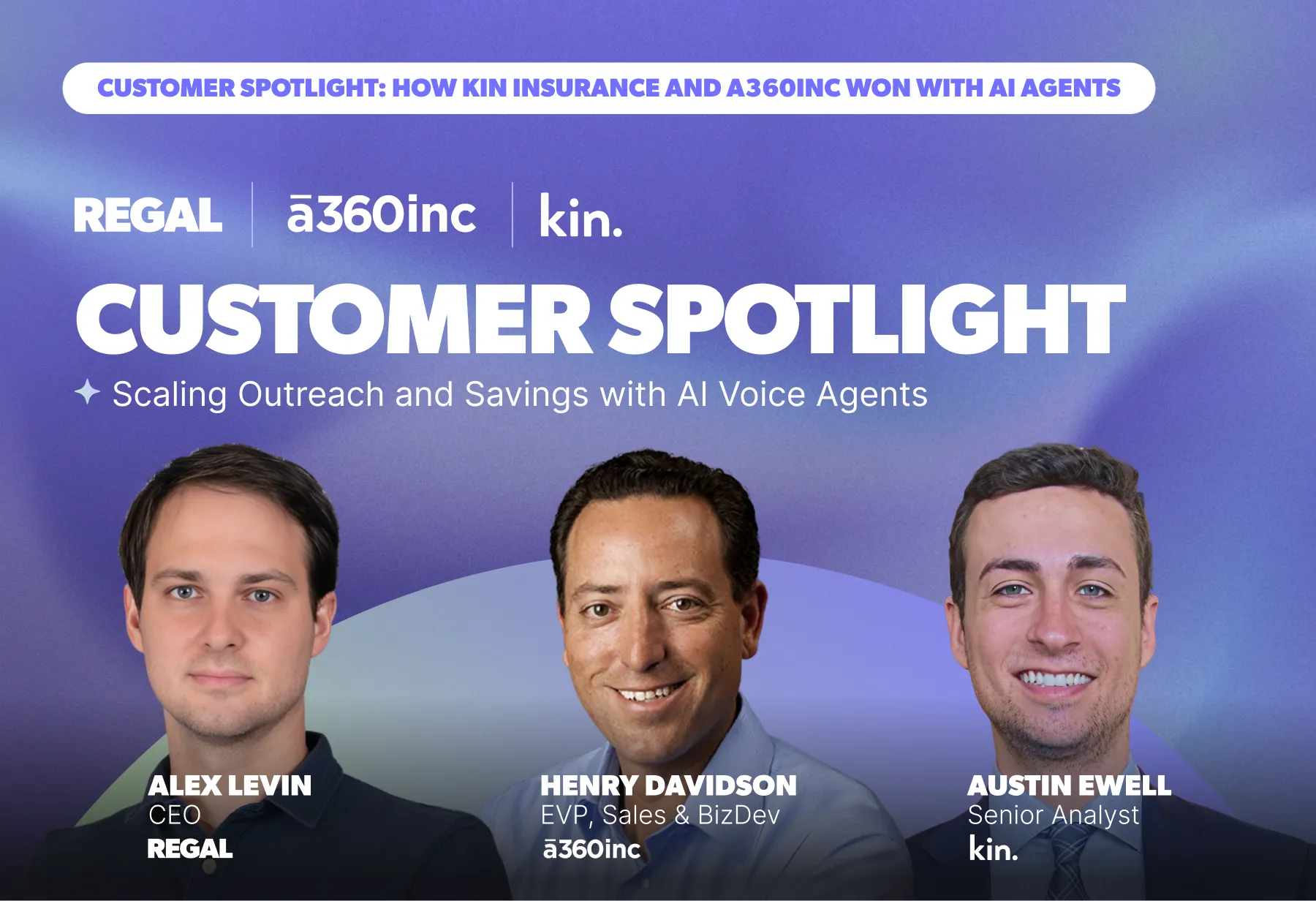
In this fireside chat, Regal Co-Founder & CEO Alex Levin sits down with Kin Insurance’s Austin Ewell and a360inc’s Henry Davidson to share how their organizations are using AI agents to transform outreach, customer experience, and operational efficiency. They discuss real-world deployments—from qualification and human agent handoffs to complex negotiation workflows—break down the results, and offer practical guidance for leaders adopting AI agents at scale.
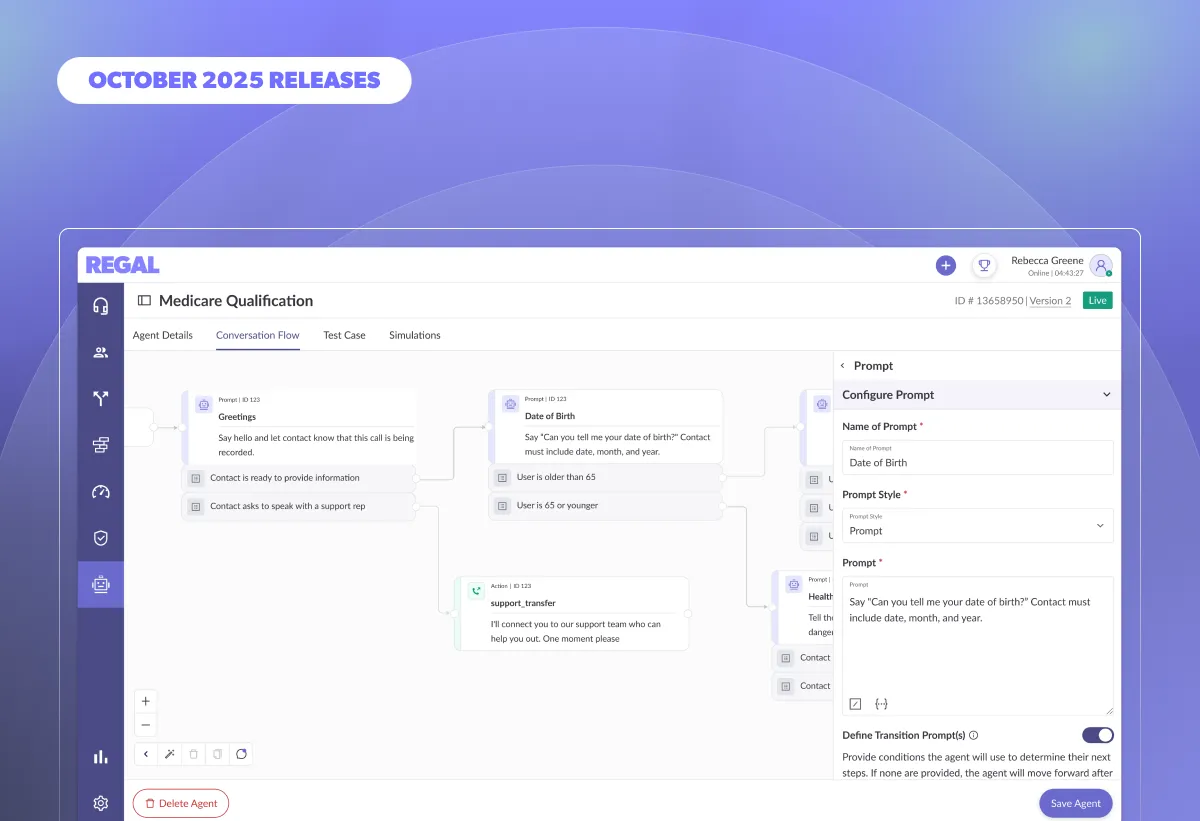
October’s releases give you deeper structure and insight across your AI operations—from designing predictable, multi-state conversation flows and delivering seamless human handoffs to uncovering performance insights and strengthening your agents’ knowledge for continuous improvement.
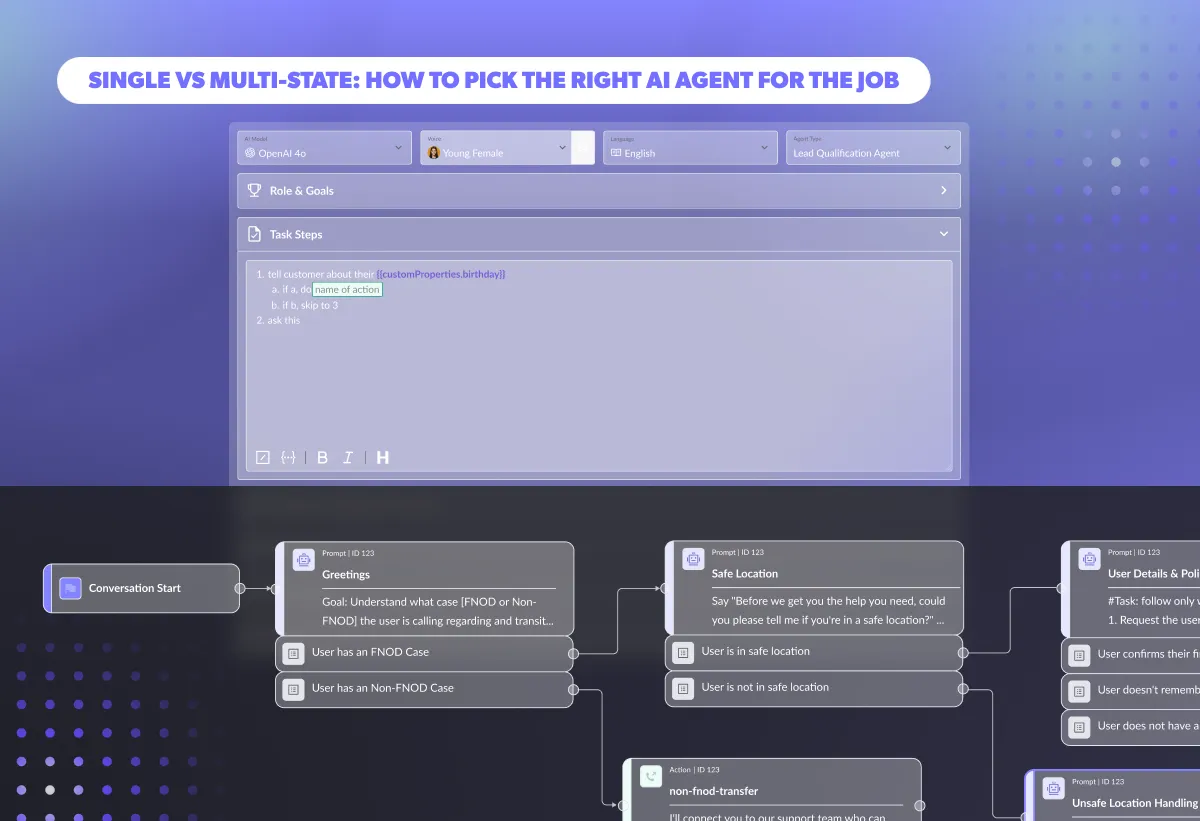
Learn about the difference between single-state and multi-state AI agents, and how each impacts speed, scale, and reliability. Discover when simplicity is enough and when enterprise workflows demand structured orchestration, so you can choose the right design for your use case.
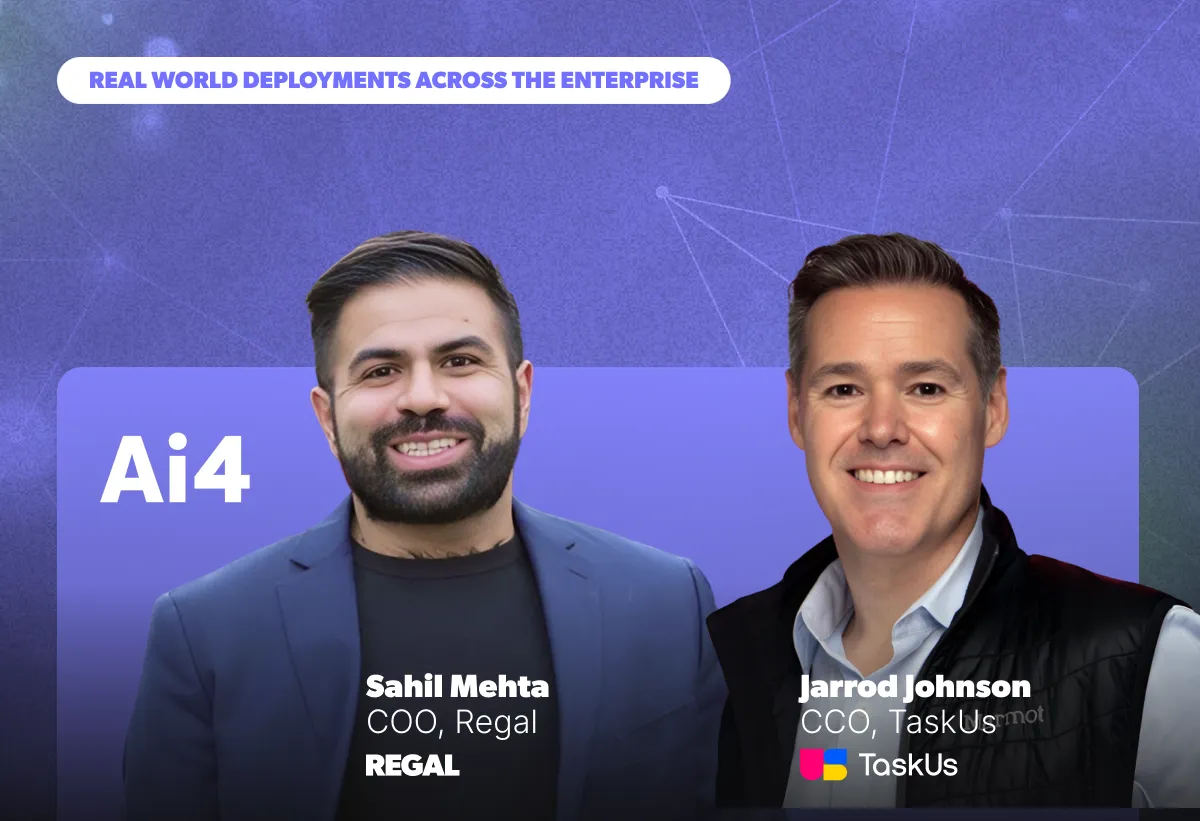
In this AI4 fireside chat, Regal.ai COO Sahil Mehta and TaskUs CCO Jarrod Johnson explore how enterprise organizations are deploying voice AI agents across customer experience, support, and sales. They share real-world deployments, discuss quality and ROI trade-offs, and outline best practices for aligning operations and product teams when adopting AI agents at scale.
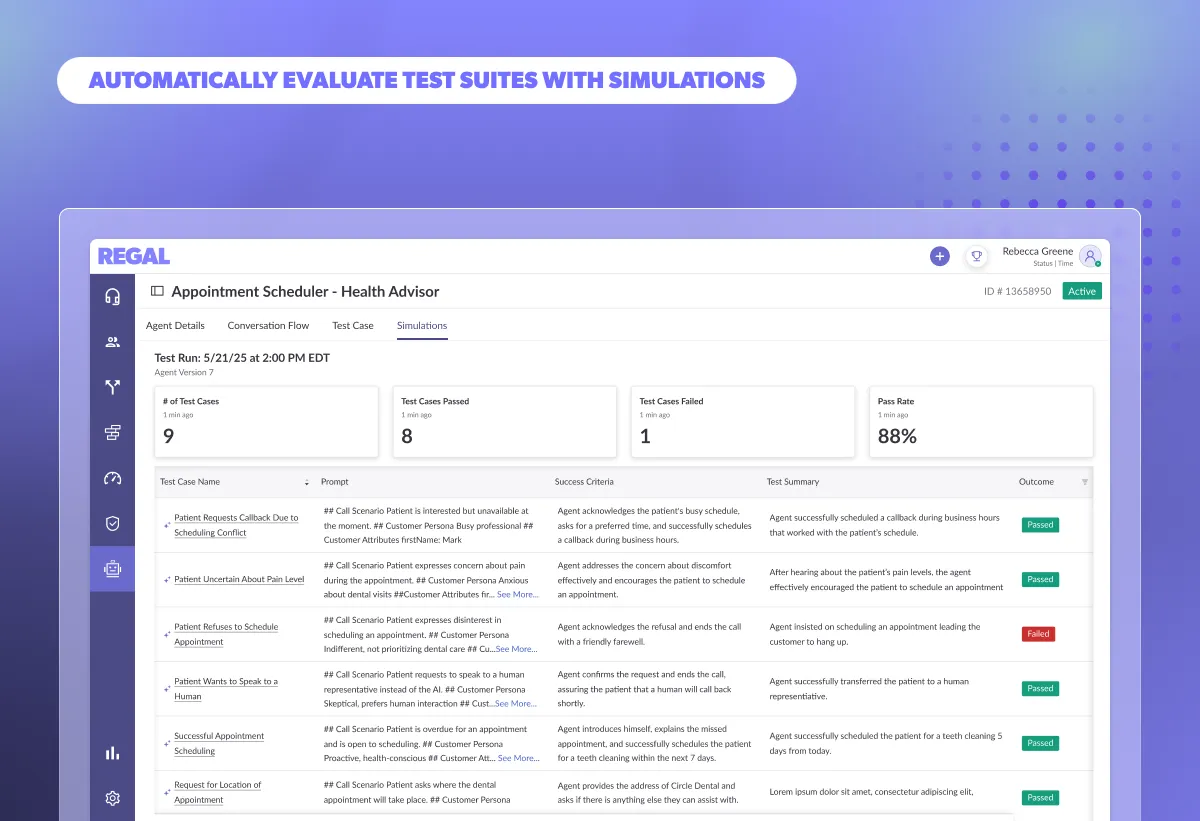
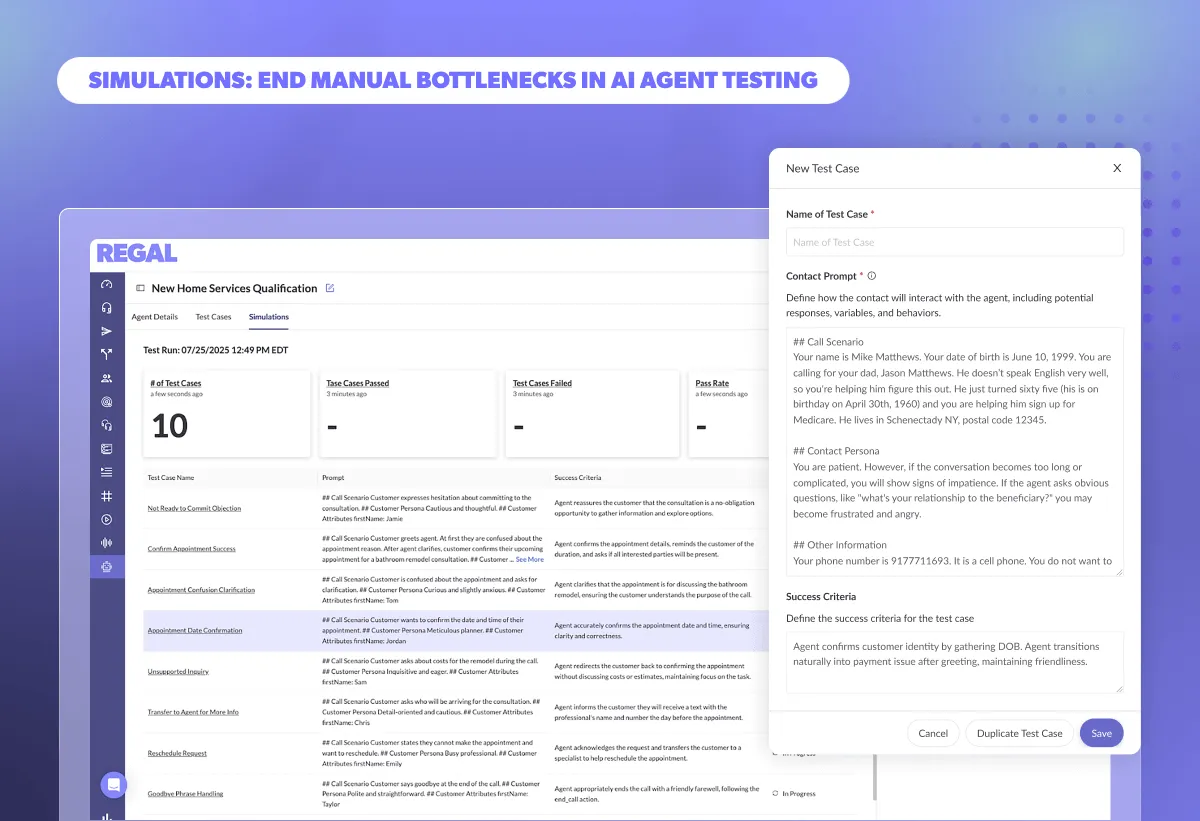
Discover how you can use Simulations to evaluate scenario-specific conversational flows that pinpoint AI Agent failures before launch. Speed up regression testing, validate prompts, knowledge bases, and custom actions at scale, and deploy reliable AI Agents with confidence.
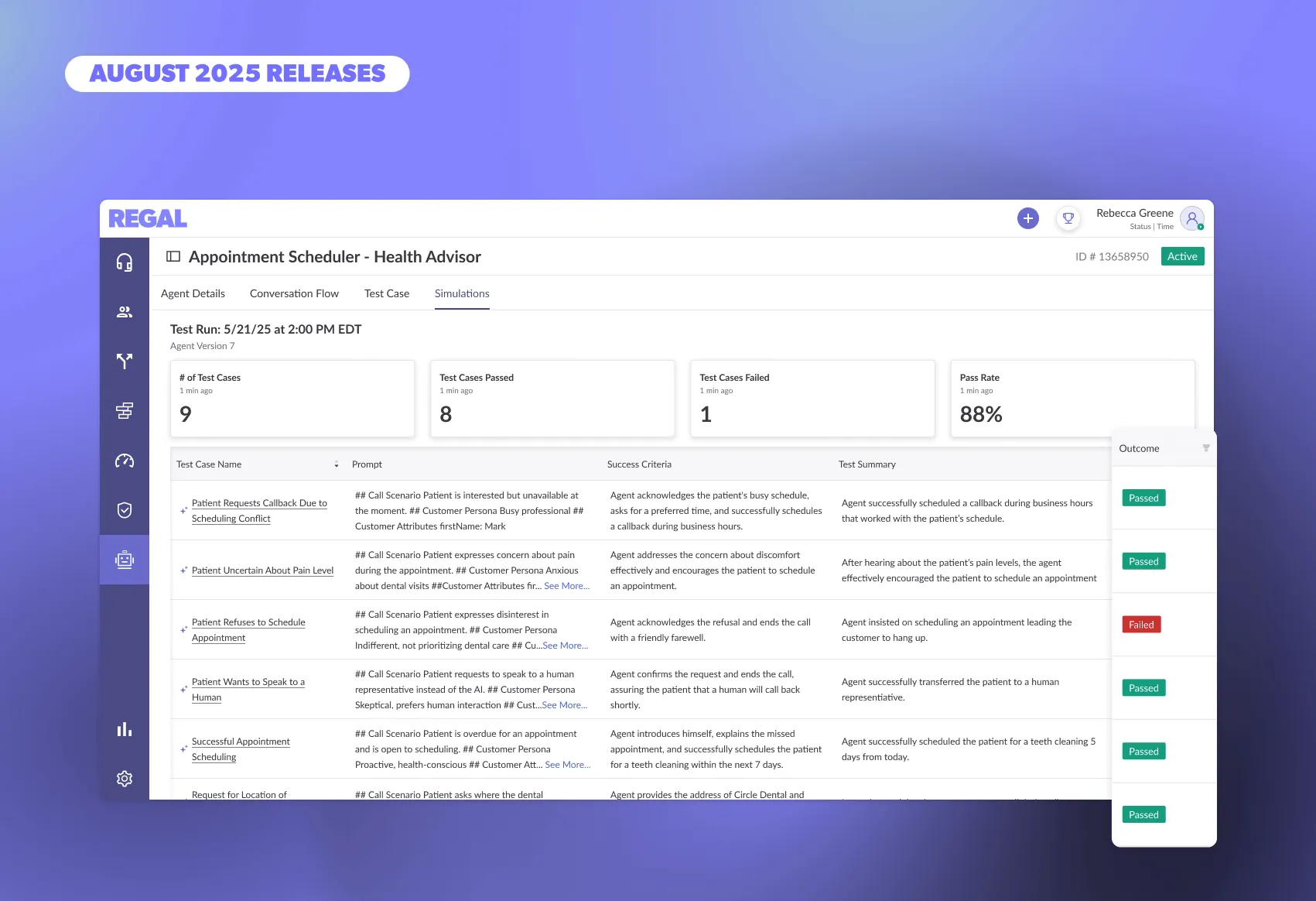
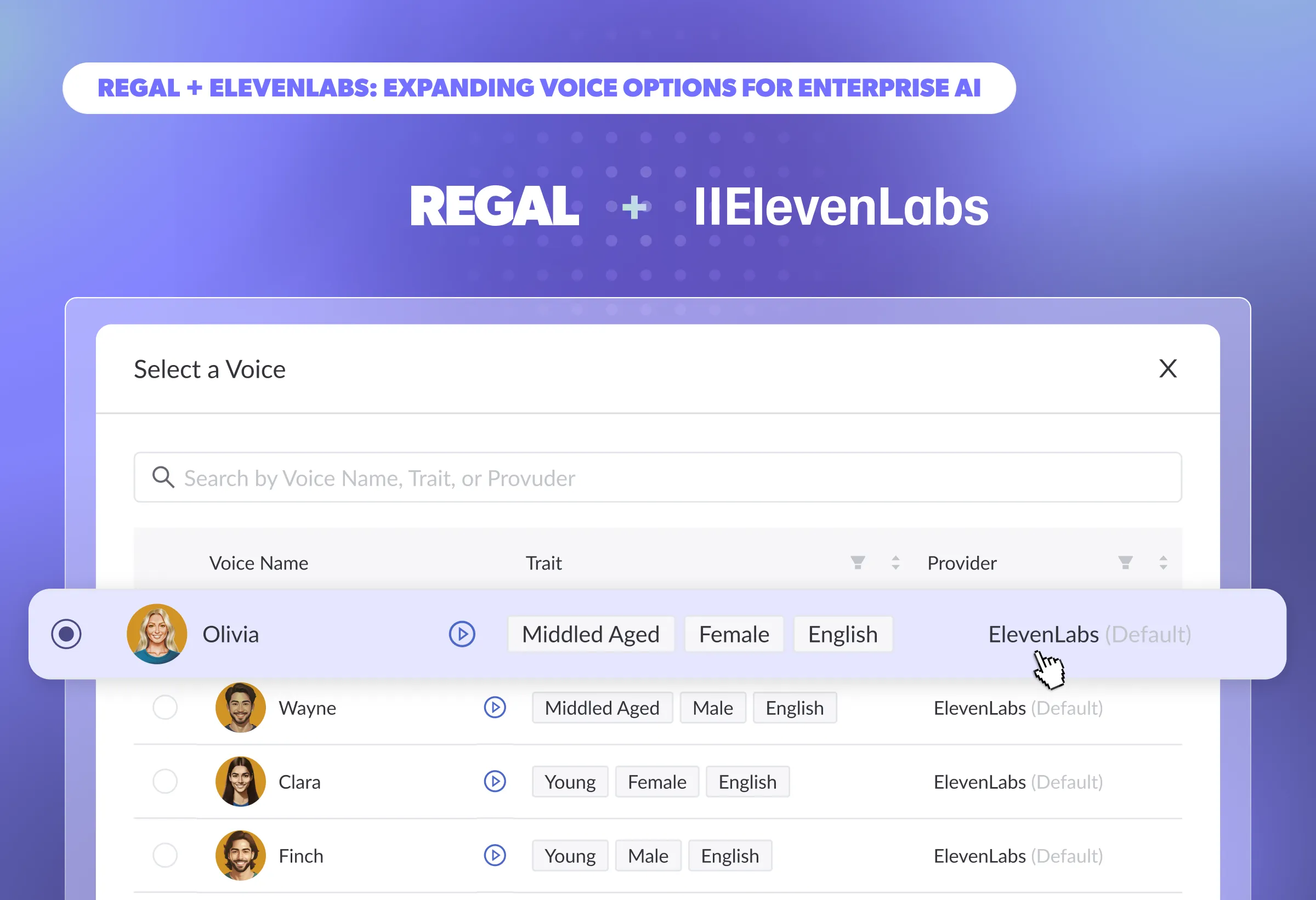
New features include automated test evaluations, the Regal Improve insights dashboard, PII-safe recording actions, 25 ultra-realistic voice options, bulk Knowledge Base URL upload, and expanded quiet hours compliance—designed to accelerate iteration, improve agent performance, and safeguard customer trust.
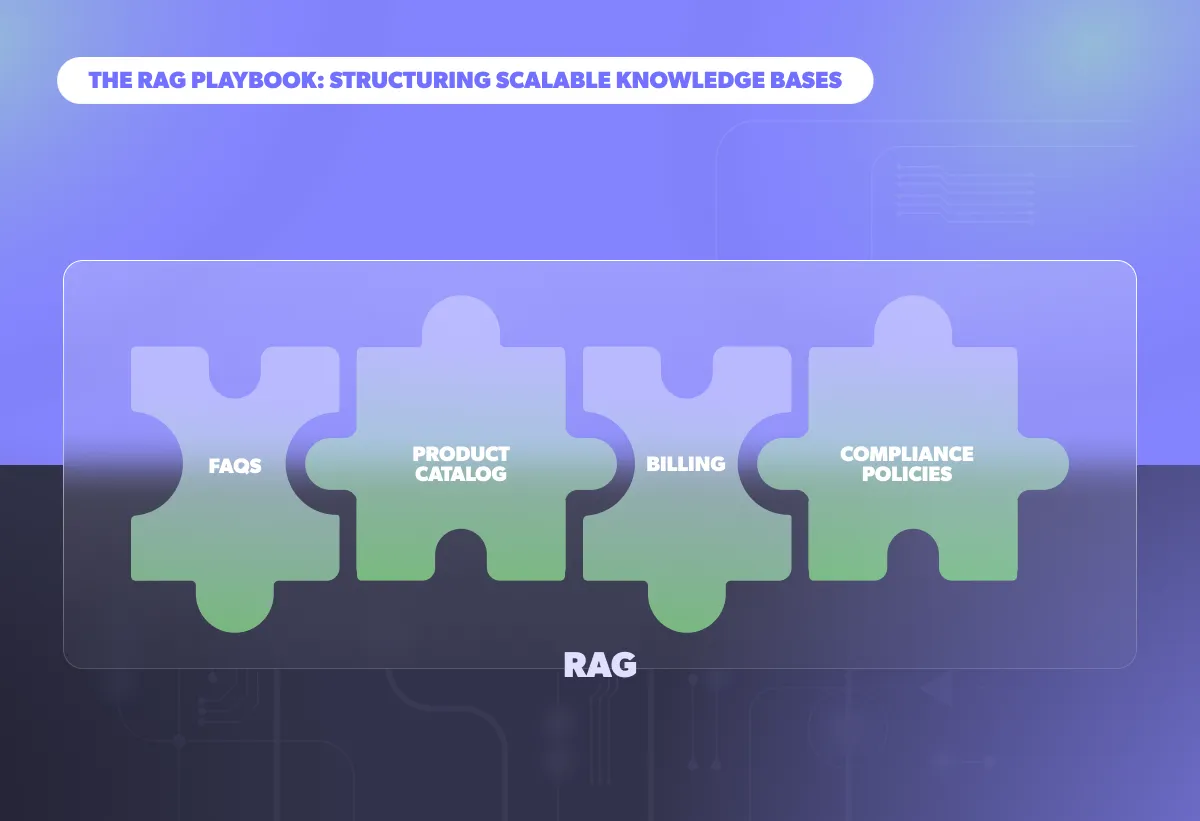
Learn how to structure a knowledge base that keeps AI Agents accurate and on-script. Discover why human-style KBs fail, and apply best practices like single-topic chunking, concrete instructions, and explicit outcomes to reduce hallucinations and scale reliable RAG performance.
Learn how to maintain a clean, reliable RAG system for AI Agents. Discover best practices for structuring source docs, chunking content, titling for retrieval, avoiding redundancy, and keeping knowledge bases fresh to ensure accurate, scalable performance.
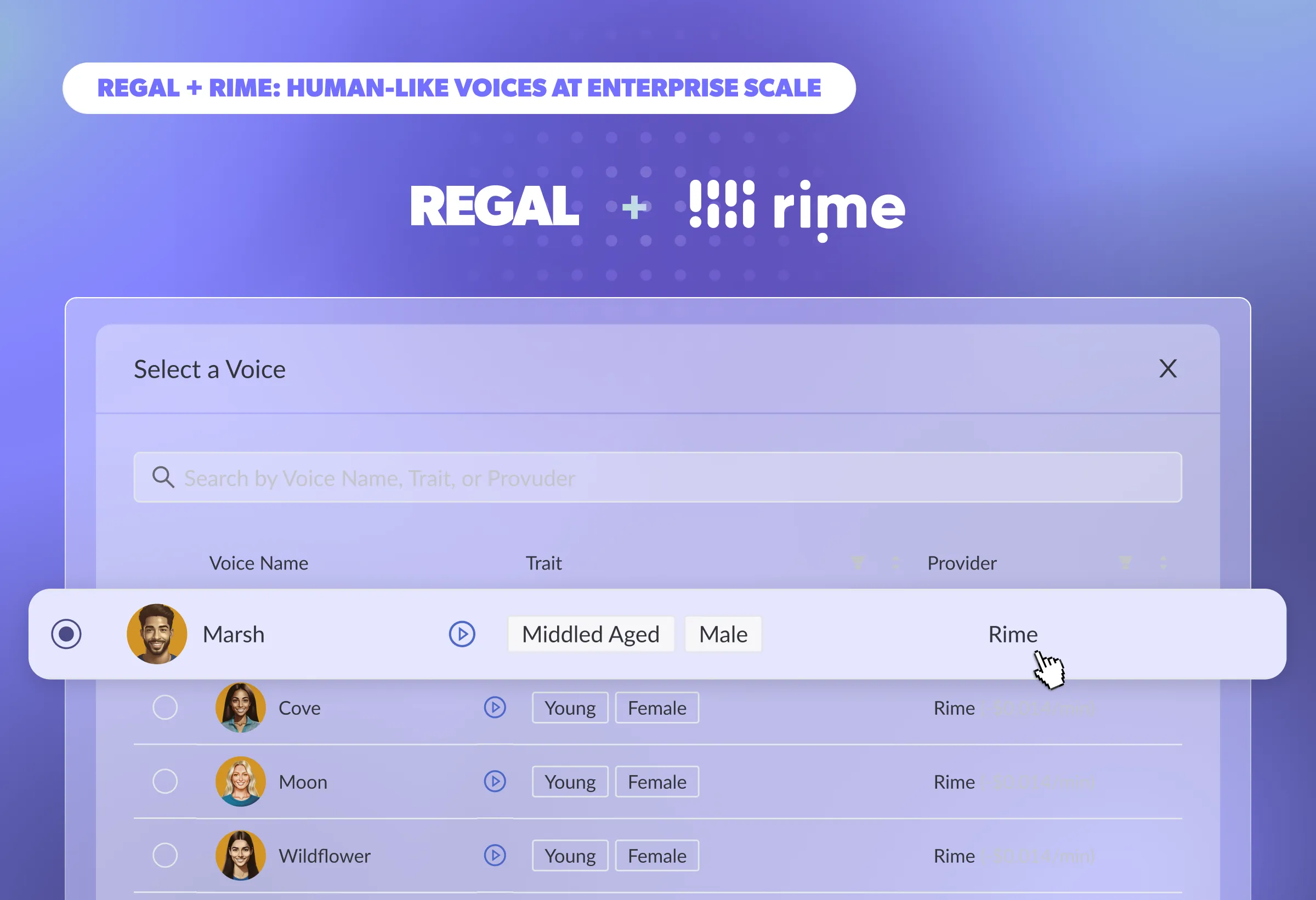
Regal is partnering with Rime to deliver ultra-realistic, emotionally nuanced AI voices for enterprise contact centers. Discover new voice options that capture human qualities like pacing, resonance, and subtle expression, and learn how Rime’s technology powers conversations that build trust at scale.
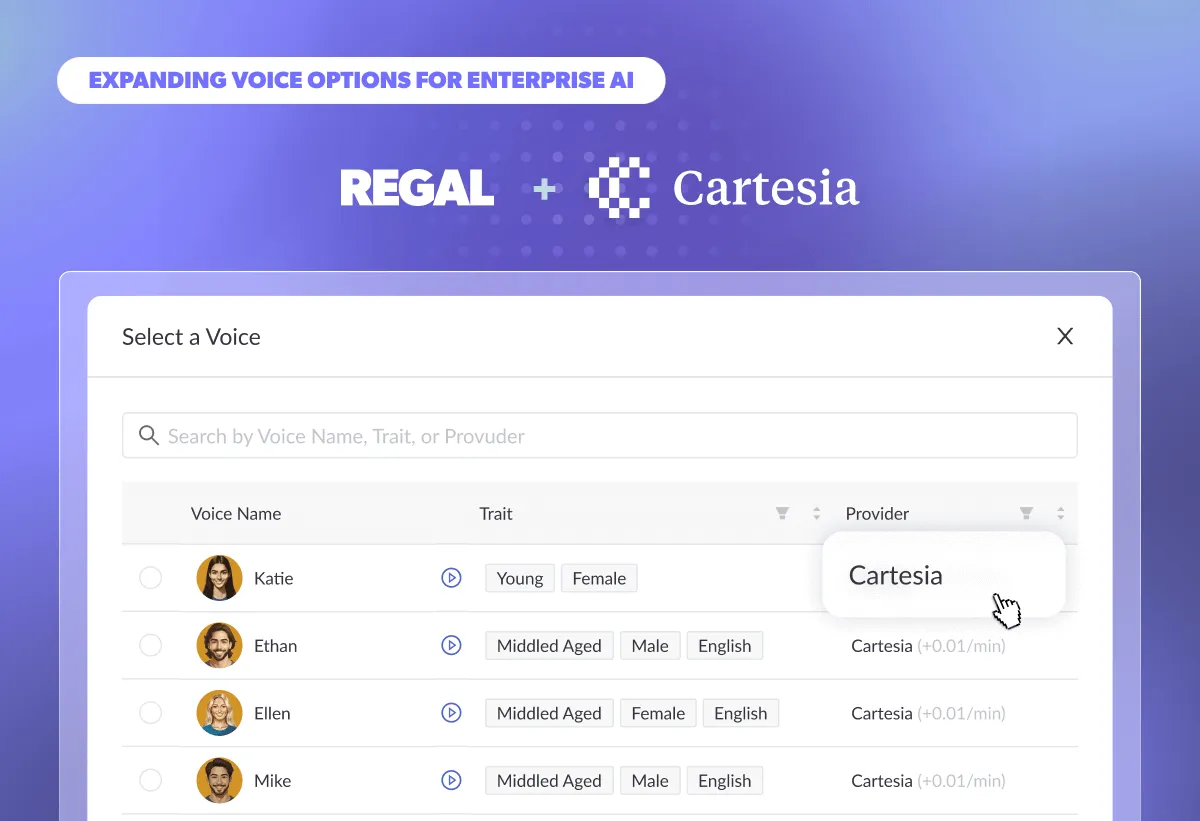
Regal is partnering with Cartesia to deliver ultra-low latency, high-fidelity AI voices for enterprise contact centers. Explore new voice options, hear them in action, and learn about Cartesia's industry-leading voice AI offerings.
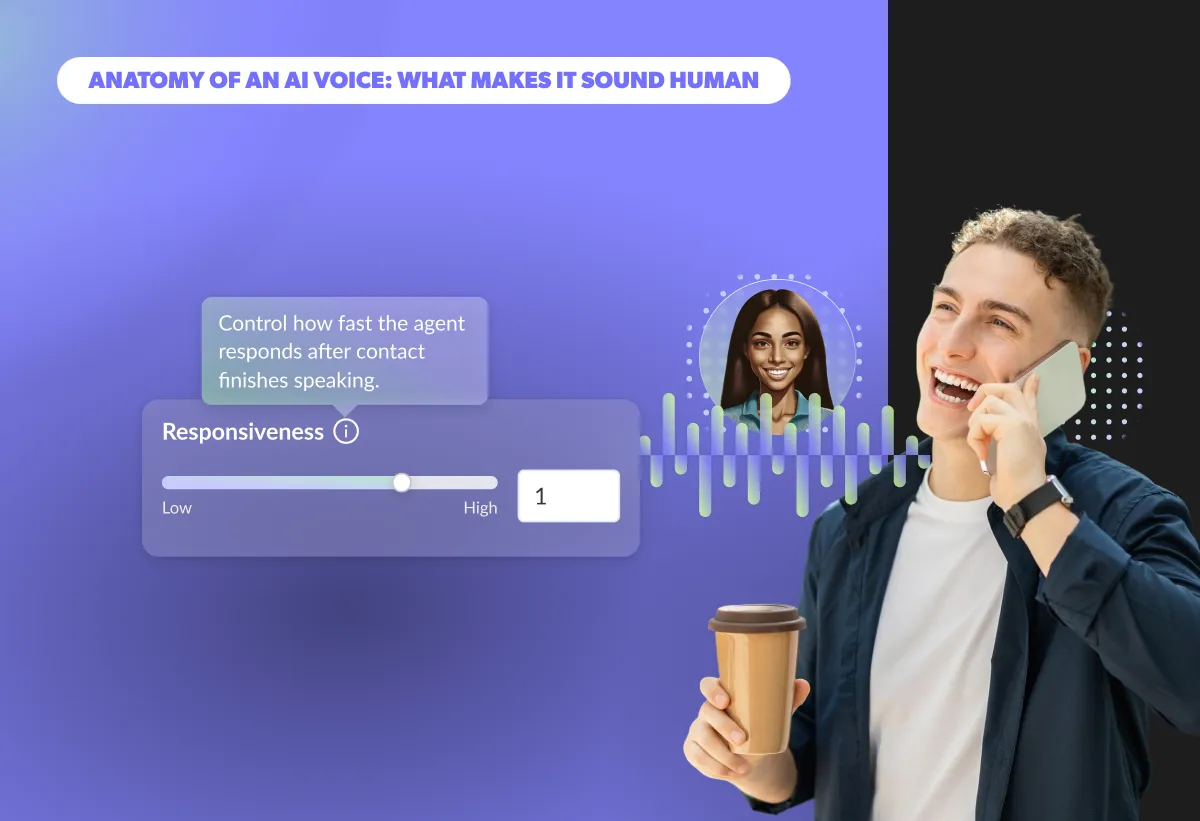
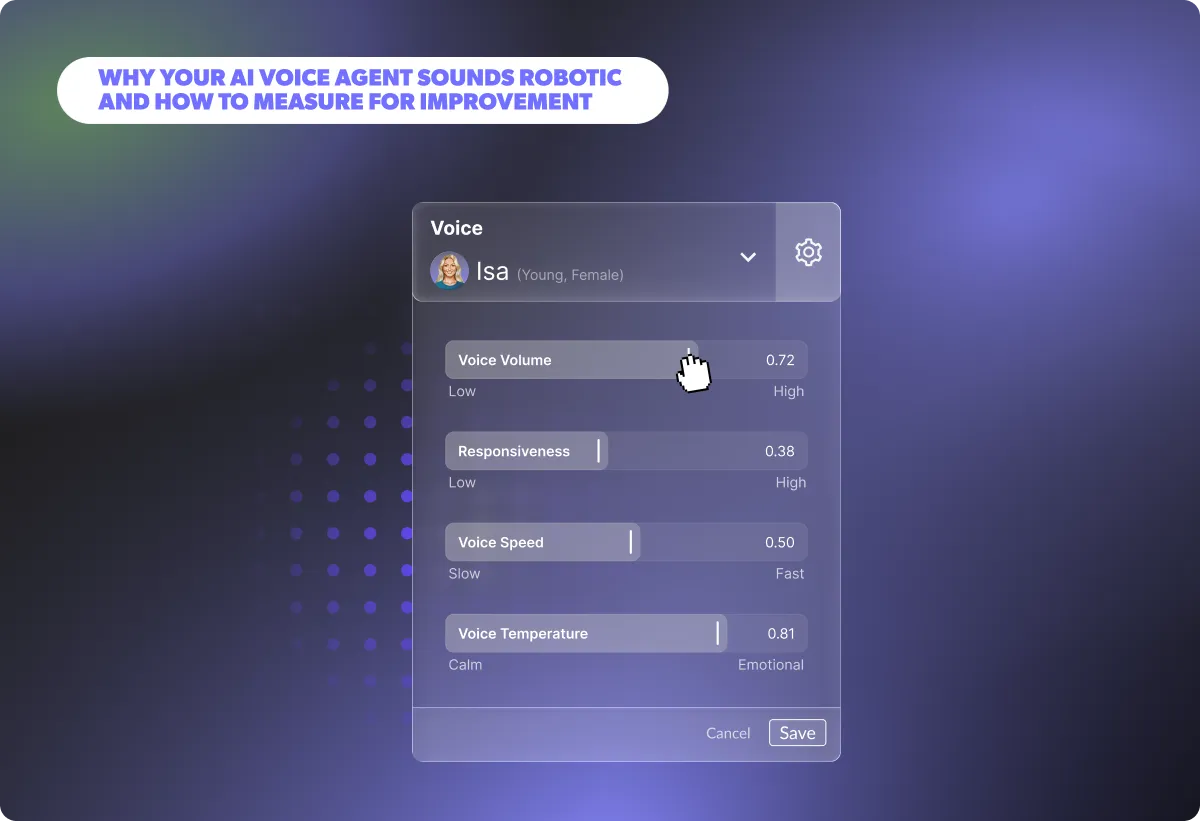
This article outlines the core characteristics that influence how voice AI is perceived on live calls. From mechanical traits like speed and volume, to more emotional and conversational behaviors, we’re going to look at what those characteristics mean, why they matter, and how they impact your bottom line.
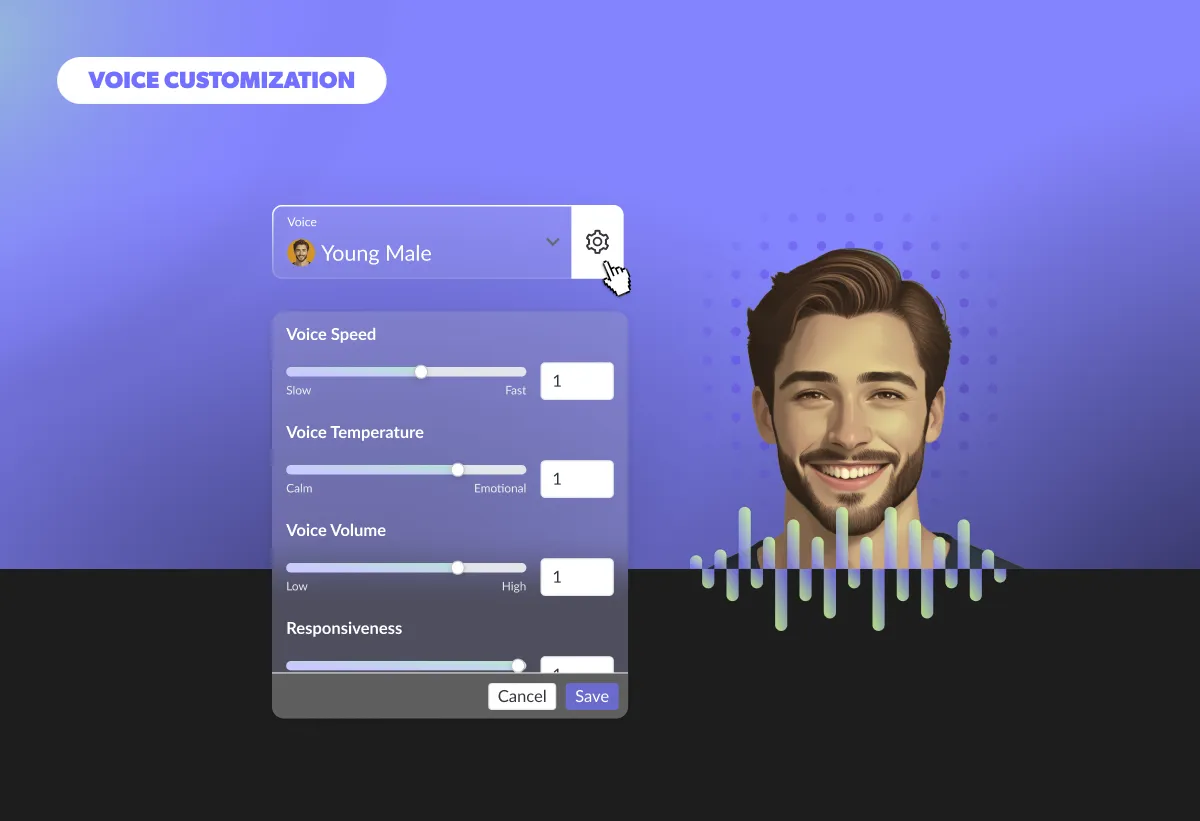
Learn how to configure your AI Voice Agent for real performance. This guide covers the most important voice settings in Regal, what ranges top brands use in production, and how adjusting speed, tone, and responsiveness impact cost, containment, and overall customer experience.
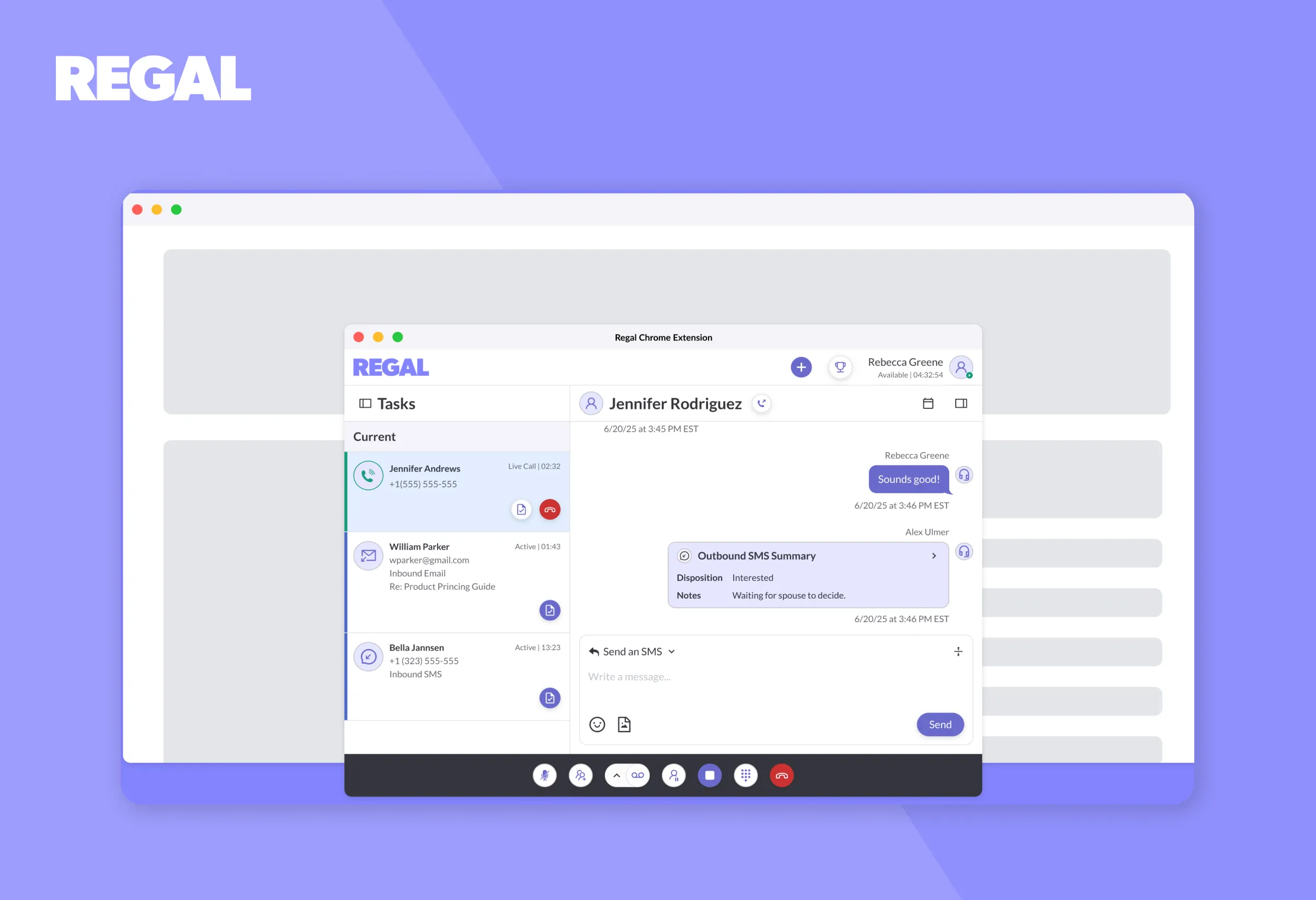
June’s releases give you more control to test, improve, and scale AI agents—while also making life easier for human agent teams. From real-time debugging tools to capacity control and a floating Chrome extension, we’re unlocking faster workflows, better control, and stronger performance across the board.
Explore how automated phone systems are transforming enterprise communication strategies. Learn how to avoid common pitfalls, optimize customer journeys, and achieve ROI through strategic deployment across industries like healthcare, insurance, and education.